Friday, April 28, 2006

The Passion of the Christ...and The Compassion of the Buddha

Dhamma Inspired Movie Review

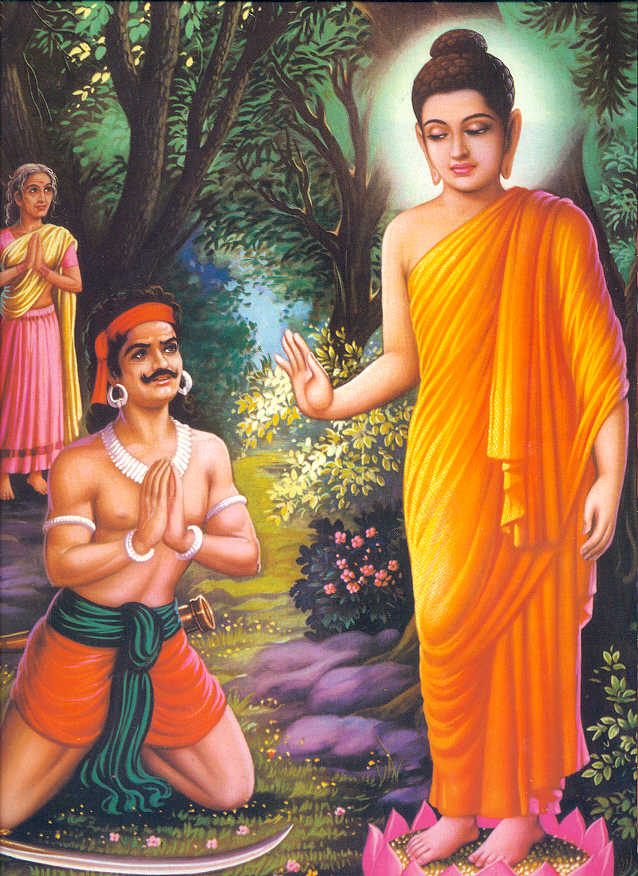
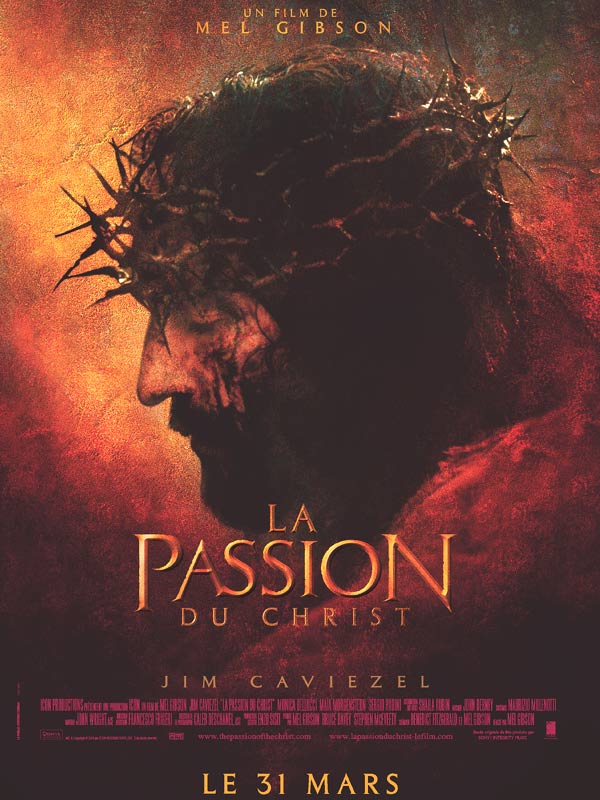
Singapore -- Both the Buddha and Jesus are among the most influential of history's religious teachers. While watching the movie, I couldn't help comparing both. Please read the following with an open mind.

While Jesus is supposed to have died for us at about 33, the Buddha lived for all...till he was 80. While Jesus taught for about 3 and a half years, the Buddha taught for about 45 years. While the image of Jesus that commonly comes to mind is that of him suffering injustice on the cross, the common image of the Buddha is that of him smiling in calm meditation under the Bodhi Tree.

While Jesus suffered greatly in his last 12 hours(as portrayed in the movie) to save all, the Buddha practised extreme asceticism for about 6 years to seek the solution to suffering for all beings. Shunning proper food and emaciated to barely skin and bones and almost died. Furthermore, the Buddha went through immeasurable hardships in many past lives to perfect his compassion and wisdom. It is said that the blood that the Buddha has bled for other beings as Buddhisatta is deeper than the deepest ocean.

The is a common "3L" argument that Jesus is either Liar, Lunatic, or Lord, for voluntarily letting himself be subjected to the great pain he went through, sacrificing himself. Since it is unlikely that he is a Liar or a Lunatic, he must be Lord, representative of the greatest love possible? If this line of reasoning holds fast, how does it apply to Lord Buddha and his countless acts of selfless compassion?

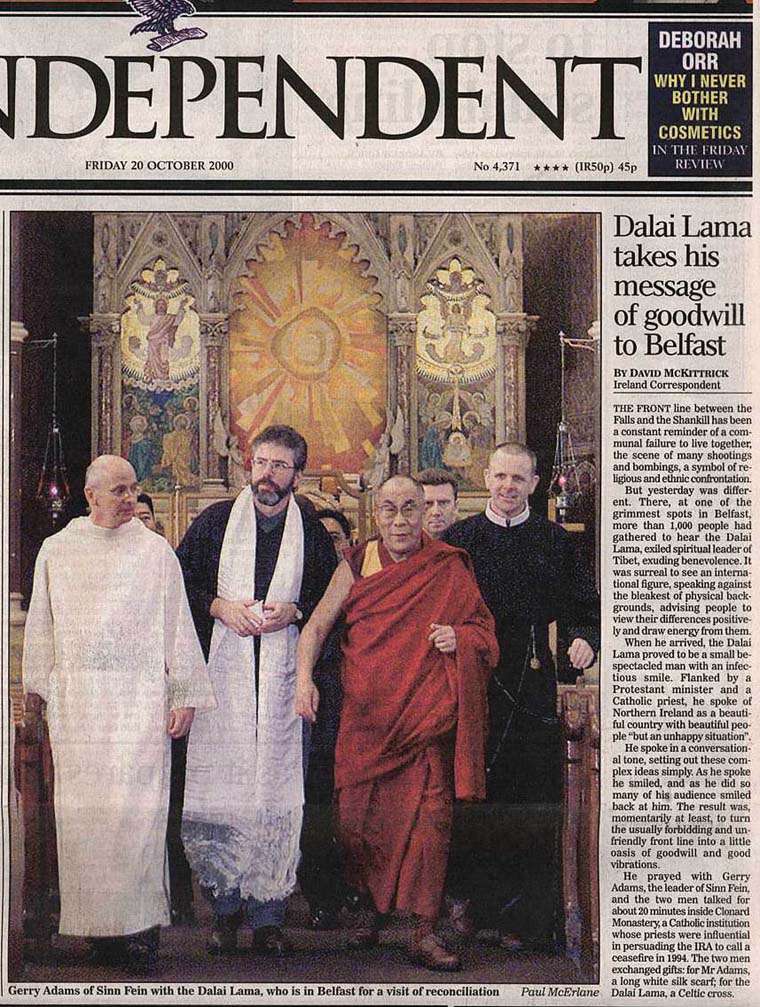
There is greatness in all religions in their own ways, which is why they can inspire so many lives for the better. Let us always keep an open mind in the spirit of harmonious inter-religious dialogue and understanding.

May all religions benefit all beings unconditionally. May all be well and happy !

Pictures source: http://home.swipnet.se/ratnashri/buddhalife.htm


By Shian(Namo Amituofo), www.thedailyenlightenment.com, April 8, 2004

Monday, April 17, 2006

The concept of real peace and its distractions

Peace is mostly used refering to happiness, contentment, stability, progress or prosperity. People have likely used this term since the appearance of humanity. However, this term has been gradually manipulated and misused for individual's or group's propaganda. Some people hold peace concept by clinging to it, some use it to justify their aggression or war, and some use it correctly owing on causes and effects or its reality of phenomenon.

As we can comprehend, some people use peace word by attaching to it. It is illusive for them. In this problem, they believe in things outside themselves. They pray or kneel to invoke for grace, help or redemption. When they are facing with fear, suffering or difficulties; they will find some outside super power or super being to make them peace. This is a type of temporary consoling their weakness. In reality, they are still confronting with ups and downs. This is called misunderstanding norm. They find peace by seeking outside power and believe in unseen or untouchable thing. Mostly, they might look over the real peace inside themselves(inner peace). For instance, people who are suffering always go to bars, gamblings or drinking alcohol. Some kneel to pray to God or creator in order to appeal Him for protection or redemption. People have been practising like this since they were born of delusion.

In other aspect, some people use the word of peace to justify their aggression or warfare. We can see many giant countries have tried to invade or creat war in other countries by accusing those of terror or atrocity. Some cases are true, but some cases are false. For example, Vietnam has invaded Cambodia and they have said that they had empathy to liberate Cambodia from genocidal regime of Pol Pot. We are thankful for their compassion. But we are sad that when everything in Cambodia is in the order, they still strenghten their forces and didn't want to go back home. Furthermore, Vietnam has tied Cambodian leaders with many agreements with them during the invasion. Now, all people around the world including Cambodians, Vietnamese, Thais and other nationalities are still wondering the controversy of April 18, 1975; January 7, 1979 and October 23, 1993 that which one is the date or era of freedom and democracy of Cambodia?

In addition, some people use it correctly according the law of causes or effects. They use it following the reality of natural phenomenon. For this group of people, the real peace is coming from the inside heart. It is the inner potential of peacefulness. They are not indulgent in seeking peace outside or appealing for grant from outside or others. Mindfulness is also known as peace. Awareness is also known as peace. Consciousness is also known as peace. Wisdom is also known as peace. Contentment is also known as peace. Or enlightenment is also known as supreme peace. Peace exists in either body or mind. It can happen only if individuals stayed in focus, contemplated, meditated or concentrated. There are many methods which people can cultivate the real peace. They can concentrate on their respiration of breathing out and breathing in. They can focus or be mindful through their four daily gestures like standing, walking, sitting or sleeping. Or they can try to be mindful in every movement of their body and mind. Such as when they are uttering; they have to be aware of conceptualizing of each word and moving tongue.

Peace is very important for everybody who are pursuing in finding real happiness. Real happiness doesn't come from materials like money, new house or new car etc. Or real peace doesn't come from the hardship practising of mind punishment. But real peace comes from understanding or insighting the three characteristics of phenomenon. These three characteristics are the truth of impermanence, the truth of decaying/suffering and the truth of non-self/non-substantiality. When people understand about these three common things of the world, they will live in the present with mindfulness and peacefulness. This is the only way; it is the way of middle path leading to the cessation of all sufferings. We must understand that, when individual peaces, the whole family peaces, the whole society peaces, the whole country peaces and the whole planet peaces finally.

Pictures source: http://www.siddharthasintent.org/peace/

Writen by P.B.Vodano

Some Exclusive Outcomes of the Cambodian New Year Festival


There are many riddles and secret stories behind the Cambodian New Year Festival. In this article, I would like to try to outline some meaningful philosophy behind the scene of this auspecious festival.

Why are there three good fortunate parts of the day?
- Three important functions of human beings leading to achievement.
As Dhammabala had answered correctly the three riddles of Kapala Brahma that:
1. In the morning, the good fate is in our face
2. In the afternoon, the good fate is in our chest and body
3. In the evening, the good fate is in our feet and toes

Firstly, human beings always wash their face in the morning. They are ready to welcome the first glance of the dawn. To wash their face refers to the purifying of six senses; the eyes, the nose, the ears, the tongue, the body and the mind. To clean our eyes in order to get rid of dusty vision such as greedy, hatred, illusion, delusion, jealousy, cruelty and stinginess. When our eyes touch the beauty of nature and society provided by the sunshine after we have already washed, it shall give us the mindful and thouroughly contemplation. Our nose is the same. It will smell the new different odors mindfully. Our ears will listen to the different sounds and voices intentionally. Our tongue will taste the food contently. Our body will touch things according to a tangible and sensitive awareness. And our mind will wander around the useful thought. If our six senses signified these washing processes; it will enrich our mind and heart with wisdom, compassion, loving-kindness and make the day a better era to live.

Secondly, our good fate is in our chest and body. Truly, we always wash our body or have a bath during this time because the weather is so hot and dry. So why is it good fate by just having showering?. Because after showering, we feel fresh to welcome good things. According to the Dhamma, we shall not wash away our bodily dirt but to wash away our dirty mind. Body and mind are essential component of our body. If we clean only body, by not clean the mind; we are considered as dirty or ugly.

Thirdly, we should wash our feet and hands neatly before bedding. It is important that if we don't clean our feet and hands, the mice or cockcroaches will come to bite or bother our night-sleep. According to the Dhamma, it means we have to prepare or be ready to rest our body and mind perfectly. So when everything is mindful before bedding, the sleeping span is peaceful and the waking time in the next morning will be peacefully and gloriously.

Why the seven Angels and people concern very much about the caring Kabila Brahma's head?
- Certainly, according to the story narrats that Kabila Brahma's head is so powerful, miracle and sacred. If this head fell down our earth, the earth will be exploided; if the head fell in the ocean, the ocean will be dried out; and if the head floated in air, the air will be devastated and has no rain. This is an interesting clue. Literally, Kabila refers to a wise old man in the history of Buddha. Brahma refers to the Sublime States of the Mind. However, Kabila Brahma in this story implies to the god of creator which people mostly call Preah Prohm. Kabila Prohm or Preah Prohm has the same concept refering to the Sublime States of Mind.

This Four Sublime States of Mind or Prohm Viheara Thor is very important to protect human beings. They are:
1. Loving-kindness : like, love, favor, content, satisfy or attentive
2. Compassion : pity, appreciate, congratulate, grace, condolence or fervent regards
3. Sympathetic-joy : altruistic joy, deep concerns, hearted feeling or condolent sharing
4. Equanimity : be straight or balancing by not biased or discriminated of four things. They are by loving, hate, fear and delusion. It must be just judgement.

Eventhough, Tevada or Angels love to take care these four sublime states of the mind and take their turn on each day of the week according to the beginning day of the new year. More than this, human beings cannot survive if they didn't have these Four Noble States of Mind in their heart.

Why god of creator like Kabila Prohm has been beheaded because of his losing in an intelligent competition with normal human person like Dhammapala?
- This is very important to illustrate to all of us that "the capacity and ability of human beings are superior than those of heavenly beings, when those human beings use their potential and keep in effort". Dhammapala is genious. He has good memory and can orally cite all the Veda canons and can understand the birds' languages.

Finally, heavenly beings like Kabila Prohm has to kneel, accept and respect the potential endeavor of Dhammapala. He beheaded himself to witness to everybody(human beings) to effort and be mindful for the individual's achievement and enlightenment.

Why do people build the sand-mount during New Year Celebration?
- They build the sand-mount for this occasion in order to worship the Veluka Cedi(sand stupa) which splaces the remains or relics of every Buddha. It also symbolizes the Culamuni Cedi in Tavatingsa heaven realm which places our present Buddha's relic, Preah Samana Godama. Sand, rice or peanuts are acceptable to make a mount during New Year time. It provides us the sense of offering, stopping all vindictiveness and unitize our society.

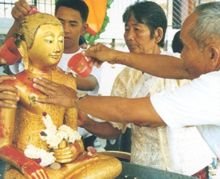
Why do people wash the Buddha's statues and sprinkle on each others?
-It is a good opportunity to wash away our bad luck by washing the representative image of Lord Buddha or the Enlightened One. As Buddha said "those who see me, see the my teachings; those who see my teachings, see me". So, Buddha's statue represents the three virtues of noblest one(Lord Buddha) such as His purity, compassion and wisdom. And also it represents His teachings and efforts to find out the way of highest bliss(Nibbana).

Water symbolizes the sympathetic mind and compassionate thought. So when we sprinkle on each others with true intention and hospitality; it offers us the environtment of peace, stability and progressive.

What do people get from this New Year Celebration?
- People get many, many things from this auspecious holiday and festival. They can benefit many different types of thing such as:
1. To learn the meaningful riddles of each year in order to repeat and remind themselves in cultivating the good, avoiding all evils and purifying their mind.
2. To have chance of family reunion and pay respect or gratitude to the elders.
3. To strenghten the national unity
4. To conserve the value of national identity, culture, tradition and way of living
5. To relax and rest their body and mind from a full year hard-work
6. To receive a chance of accumulating merits by offering food to the Bhikkhu monks, help poor people, and fostering the contentment of living.
7. To enjoy traditional games, colorful clothing, friendly associating and other entertainings.
(Cambodian Traditional Fashion Clothes for Cambodian New Year. Picture of LowellSun)
Compossed by P.B.Vodano Sophan
Reference:
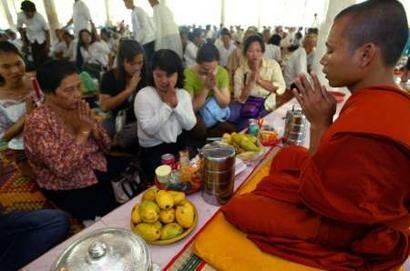
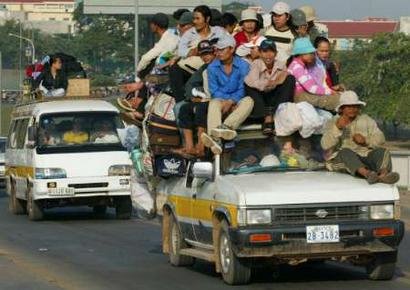
- Pictures source of Cambodian New Year Celebration at Kompung Speu Province by REUTER/Chor Sokunthea and Khmer Krom Pictures Collection

Wednesday, April 12, 2006

Cambodian New Year: History, Perspectives, Social Value and Glance of Pride


History
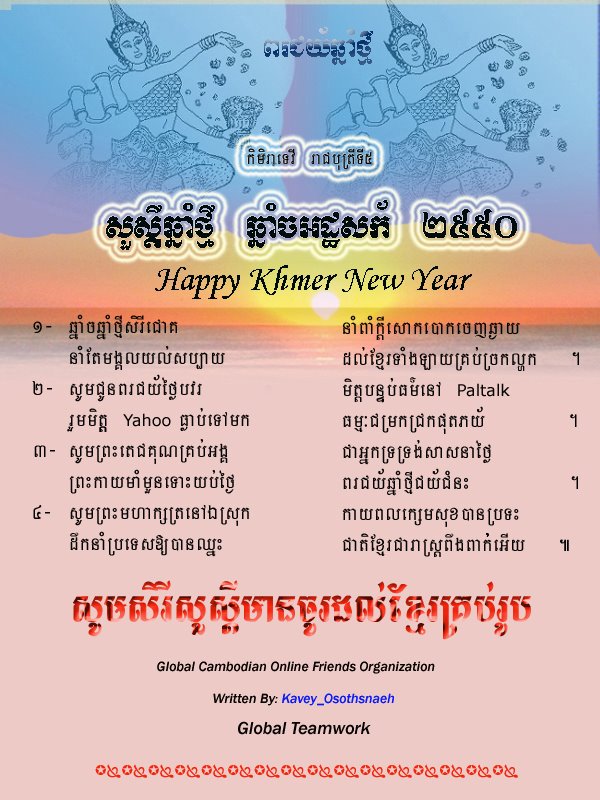
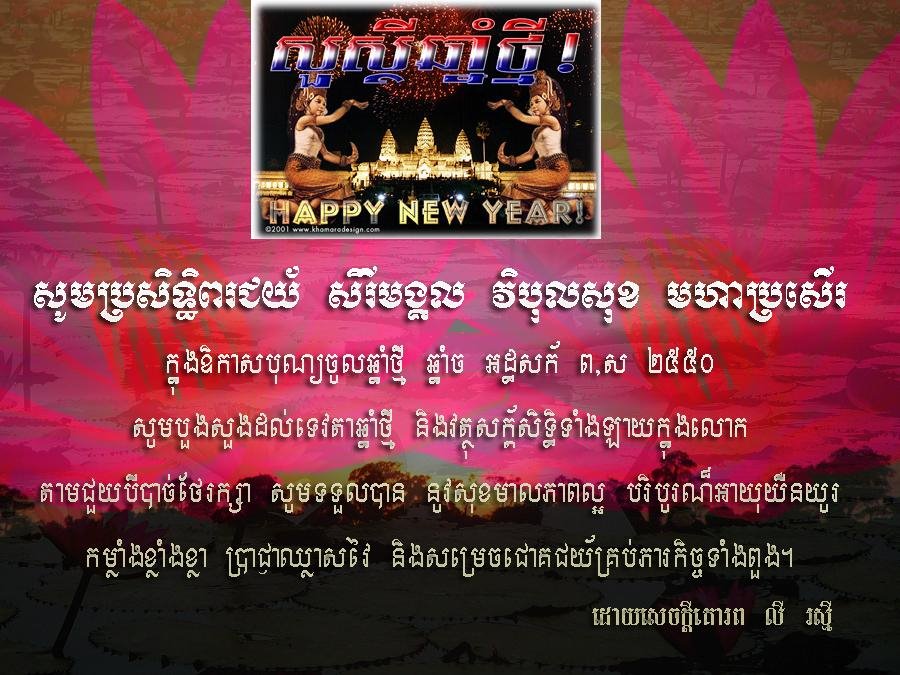
Bon Choul Chnam or Cambodian New Year is a solemn occasion for everybody. It is also celebrated in Sri Lanka, Burma, Thailand and Lao. It is held in Khae Chaet lunar month (April) each year. It normally falls on the first, second and third day of waning moon(dark night) or April 13, 14 and 15. This year is the anniversary of 2550 according to the Buddha's era that Cambodian people celebrate their new coming year.

Actually, Buddha era is counted while Lord Budda passed away(Parinibbana) in the full moon of Vesha(May) 543 B.C. In most Asian countries use lunar calendar which first month(Megase) starts around 1st, 2nd and 3rd of January in each year. According to some of Khmer records states that in the past Cambodian people and the kings celebrated new year in the first day of Migase month(January), but after that they have changed to celebrate in April. They change the date because of the rice harvesting season. During the month of Migase, Bos, Palaguna; Cambodian farmers are busy to cultivate their crops and store it the barn. So during Udong period, the king had changed the date to celebrate in Kae Chaet(April). This changing is appropriate to the time, condition and situation as this month the weather is dry-hot, people are free from all farming burdens and they like gathering in the shade to protect themselves against the bright, hot sunshine.

Perspectives
There are two aspects to do rightly in this auspecious New Year Arrival. Firstly, Cambodian people celebrate it according to the tradition and culture. Secondly, according to the doctrine of Buddhism. Traditionally, Cambodian people are regardingly looking forward the coming of new coming Angel each year. There are seven angels representing seven days. Those angels are the daughters of Kabila Prahma(god of protector, but it literally means the Four Sublime States of the Mind: loving-kindness, compassion, sympathetic joy and equanimity). Those daughters take their turn to take care the Sacred Head of their father. Legendary story said that if this Sacred Head dropped in the earth, our earth will be exploided; if it dropped in the sea, the sea will be dried out; and if it floated in the air, the air will be devastated. This year is Chnam Chor or the year of dog; and the new year day falls in Friday, so that the Friday Angel's name is Kimira Tevi who will take turn to look after her father's Sacred Head. She will arrive at our earth at 6:48 AM of April 14th.

The cause leading to the beheading of Kabila Prahma came from his defeat in an intelligent competition with Dhammapala(a righteousness protector). This wise young man can answer his three questions about what are the three fortune periods of the day?. And he answered that "in the morning the good bless is at our face, in the noon the good bless is at our chest, and in the evening the good bless is at our toes". By telling this correct answer, Kabila Prahma god agreed to compensate his head for this correct answer; and also in order to save the world. We can notice that eventhough Brahma God has to respect the effort and wisdom of human being like Dhammapala.

On the other hand, according to Buddhist doctrine, there are many Angels(they were born according to their good deeds during spending their time as human beings) in this universe who always come to protect those good people. Importantly, all children have to pay respect to their house-angel(Tevada Pteah) whom are our parents. In this rarely opportunity, all children offer gifts, presents, food or others to their parents. They also apologize their intentional or unintentional mistakes which they have created.

Social Value
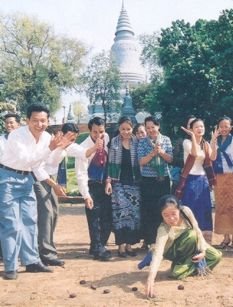
In this occasion, people always clean the Buddhist temple yards, accommodations, villages and public sites, and also decorate them with beautiful ornaments, flowers or glittering lights. They also clean the Buddha altars in each home, spraying perfume and purifying the mind to welcome new angel who brings along with happiness and grace for them all. There are three days which the first day of new year is called Sangran meaning moving, second day is called Vanabot meaning taking shelter in the shade or a break and the third day is called Lerng Sak meaning the coming new year. People practise accordingly to these important three days such as they prepare food and four necessities to offer to the Bhikkhu monks at the temples in the first day, they stay in home with all family's members and do something fun together in the second day; and they will build sand-mount, sprinkling water to cleanse Buddha's statues and sprinkling water on each others happily. During these three days, they are also playing many types of Cambodian traditional games like Choul Choung(throwing a type of long tail cushion), Boh Angkunh(bowling the fruit nuts), Teanh Proat(tug war competitive) etc.

The most important activities in this auspicious occasion are the preparation of food and the four necessities to offer to the Bhikkhu monks in order to dedicate merits and welfare to ancestors; to apologize parents and give special gifts to them. We also apologize to the elderly people and teachers. People virtually cultivate the good deeds such as offering(Dana), observing precepts(Sila) and meditating(Bhavana).

The activities mentioned above resulting the social value to Cambodian people. It can bond people in a larger unity, prosperity and enjoyment. Gradually, it has become the symbolic happiness time for the people and provide the unforgetable memory to all children.

Glance of Pride
Cambodian new year contribute the taste of harmony with a particular pride. As it is a three days holiday; it can offer enough time to all citizens to the reunion of their family. As it is a long historical, traditional holiday; it can identify the unique diversity of Khmer culture. As it is a Buddhist ritual day; it can enrich Cambodian people with strong spiritual adherent and peaceful contentment. As it is a summer new year; it can entertain people to relax their mind from a whole year of stressful tasks.

This occasion is memorable. It is appreciate to welcome all people not only Cambodians, but all those who like new tasting of adventuring and entertaining; they can come and join this wonderful nw year celebration. Cambodian people are hospital, friendly and smilingly. The Bayon smiles symbolizes the "Land of Smiles" in this kingdom. Many visitors who come to join this ceremony have never forgoten their day. They had seen people dressed themselves with colorful, delicate clothes(Khmer silk), friendly local people and kids; spraying cool water and playing games; and experiencing crowd of people who are commuting on the streets, markets, bus-stations, attractive sites etc.


This sample essay is writen by P.B.Vodano Sophan
More useful links:

Tuesday, April 04, 2006

Angkor Wat: a famous place for visitors around the world

iBT Toefl Test (Sample Essay)
What famous place would you like to visit?
Use details and reasons to support your response.
Time: 30 minutes, Length=300-400 words
----------

There are many places and options for all visitors on how to relax their mind from the stressful conditions. Someone choose to visit a natural beauty, a modern city or extraordinary ritual event; while someone choose to breathe with the ancient piles of stone and world's wonder heritage. Personally, I would like to visit Angkor Wat Temple which is the oldest one of ancient ruins of Cambodia, decorated by beautiful sculptures and the sense of pride and hope for Cambodians.

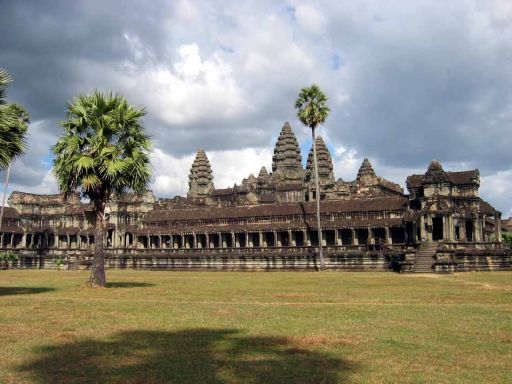
Angkor Wat Temple is one of the world's ancient largest monuments are made by sandstone located in Cambodia. It was built by King Suriyavarman II(1113-1150) in the city called Yasodharapura(city of Isvara Linga). This city was primarily created by the King Yasovarman who moved from Hariharalaya city far east about 10 km. of Angkor Wat. There are many ruins scattering in this new city. But Angkor Wat is considered as the largest and most beautiful one. It seems erected in the middle of administrative area which can be considered as the heart of the emperor kingdom. Actually, there are many ancient ruins in Cambodia but Angkor Wat is recognized as the most powerful and strongest one. During that time, there were only two rival kingdoms comparable with Cambodia kingdom; eastern Champa state and northern Mon state. So we can say that Angkor Wat Temple was the only one largest temple and strongest power in the region of South East Asia before the emergence of Siam and Dai Viet(presently Thailand and Vietnam). This is what I said it is the oldest one among Cambodia's ancient ruins.

Beside of the oldness of this important temple, it has decorated and splendid by the extraordinary sculptures. In every corner, spot and space are rich of talent carvings. When we look at the wall we can see the celestial Apsara dancers, when we look at the roof we can see the serpent line motif and the story-telling lintel, when we look at the columns we can see the rose motif decoration..etc Among these sandstone decoration, the Apsara dancing is majestic and awesome. There are approximately 1,600 Apsara dancers are adorn throughout the monument. But they are very different and having the unique characters. Some are smiling with teeth and tongue, some are dressed with delicate bra and short sarong but some seem have no dress at all. Those are also beautified with different attractive hair-dressed models. Some modern hair-dressed fashion have learned and copied those ancient styles. It is undescribable about the beauty of this sandstone sculptures and base relief, so that why I think it is the most beautiful decoration.

In addition, Angkor Wat Temple offers the sense of pride and hope. It isn't a symbol of humanity's talent and effort, but it is the icon of unity, peace, wisdom and stability of Cambodian people. There are many evolutionary changes of Cambodian ancient ruins development, it had started from the Phnom Da style of art to the highest achievement of Khmer style of art of Angkor Wat. It has been passed for more than one thousand years and left thousand of ruins spreading throughout the region in Cambodia, Thailand, Laos and Vietnam. Through this achievement, it has paved the red carpet of struggle, power and bravery. And it is the pride and hope of Cambodians as someone said about it anonymously that "To Khmer People, Angkor Wat is more than just an ancient pile of stones, it is more than just the remains of a highly advanced kingdom, it is more than just atourist attraction - to the Khmers it is a symbol of hope."

Through the old antique, beautiful decoration and pride of humanity that leads Angkor Wat to be well-known and recognized throughout the world. In the 14th of December 1992, the UNESCO World Heritage Committees declared the monument, and the whole city of Angkor, a World Heritage Site. Especially, Angkor Wat is the seventh wonder of the world with its enormous size, the most beautiful decoration, powerful administration symbol and legacy of human's endeavor. In a time of our life, I suggest that, we have to go and see Angkor Wat like an English writer Arnold Toynbee said "see Angkor Wat and die".

This essay is writen by VODANO SOPHAN