Thursday, January 25, 2007

Dispute Threatens Trial of Khmer Rouge Leaders

By SETH MYDANS
Published: January 25, 2007
Source of this article: The New York Time


PHNOM PENH, Cambodia, Jan. 25 — _ The Cambodian judges were on one side and the foreign judges on the other this week, in a dispute that captures a decade of difficulties in bringing to trial the last surviving leaders of the murderous Khmer Rouge.

If the judges cannot agree on procedural rules soon, analysts and officials at the tribunal say, some of the foreign judges may walk out. That would cast an even deeper shadow over a process that some critics say is already so compromised as to be of doubtful value.

Seventeen Cambodians and 12 foreigners were empaneled as judges and prosecutors in the matter last July, inaugurating a United Nations-sponsored process that mixes Cambodian law with international standards of justice.

It is an awkward formula, made all the more questionable by the meager qualifications of the Cambodian judges, who were appointed by Prime Minister Hun Sen and are answerable to him.

Pragmatists say that a flawed trial is better than none at all, and that there is no choice but to proceed with the tribunal one has rather than the tribunal one might wish to have.

Three decades have already passed since the Khmer Rouge ruled Cambodia with a brutal hand, causing the deaths of 1.7 million people from 1975 to 1979 through killings, torture, starvation and overwork.

The trial, meant to be of “those most responsible” for the crimes, is expected to focus on, at most, a dozen targets. Most of the potential defendants are very old and some have already died — notably the supreme leader of the Khmer Rouge, Pol Pot, in 1998. Among those still alive, only one is now in custody; the rest live freely in Cambodia.

Robert Petit, the Canadian lawyer who is serving as co-prosecutor in the case, has been actively gathering evidence but has not said where it is leading him.

In an interview, he said he was ready to propose his first indictments once the judges had formalized the court’s rules, at a plenary session tentatively set for March. The trial itself might then begin by the end of the year.

Cambodia and the United Nations reached an agreement on the structure of the mixed tribunal in 2003, after years of negotiations over both technical and political differences.

Those differences remained at the heart of the disagreements that have stalled the process since last November.

A rules committee of nine judges is trying to resolve the differences. Sean Visoth, a Cambodian who is the tribunal’s coordinator, said, “If there is no compromise and there is no plenary, the international judges will walk away.”

The delay has revived an old concern that Mr. Hun Sen may not in fact want the trial to proceed, and may instead be creating the latest roadblocks in a long series that have impeded progress for years.

Among other things, he is believed to be under pressure from China, which presumably would be embarassed if a trial directed international attention to Beijing’s former close ties to the Khmer Rouge.

There are more than 100 procedural rules, some quite complicated, for the judges to agree on. But the core disputes appear to involve one fundamental, long-running issue: securing the trial’s independence from Cambodian political manipulation.

On the Cambodian side, control is an important concern, according to the American ambassador to Cambodia, Joseph A. Mussomeli. “The government in general tries to keep tight control over the judiciary and anything that could have negative consequences,” he said.

In a country where the politics of the present remain tangled in the past, the proper scope of the indictments is contentious. Some former middle-ranking Khmer Rouge officials are prominent in the current government, including Mr. Hun Sen — although experts say he bears no responsibility for the regime’s atrocities.

Some potential defendants may also have powerful patrons who are trying to protect them.

According to people briefed on the negotiations, the judges are at odds over a complex proposed rule that would in effect allow an indictment to proceed without the agreement of the Cambodian side. That provision is one of several balancing acts in the tribunal’s supermajority system, which in most respects gives the foreign and Cambodian judges veto power over one another’s decisions.

The Cambodian side is also seeking to limit the right of defendants to be represented in court by foreign lawyers, which it says is a violation of Cambodian legal sovereignty. Foreign analysts say the Cambodians do not want aggressive defense lawyers who are independent of any political guidance to move the case in unpredictable directions.

A British lawyer, Rupert Skilbeck, who will coordinate the lawyers’ work, said defendants would be placed at a disadvantage if they could not select their own lawyers.

“It’s important that the trials are very fair, because if they’re seen as show trials, then there will be no justice,” Mr. Skilbeck said in November, speaking to the Cambodian Bar Association, which is closely allied with Mr. Hun Sen and which opposes participation by foreign lawyers.

Mr. Mussomeli said the Cambodian government, accustomed to controlling the judiciary, might be reacting defensively to Mr. Petit, who has taken on his job as prosecutor with an energy and independence that is unfamiliar here.

In the interview, Mr. Petit sought to calm these concerns, saying he was aware of the sensitivity of his role and of the possibility that the tribunal could be derailed by an overaggressive prosecution. “We have to apply the law in the context of Cambodia,” he said. “I’m not stupid. You have to exercise discretion.”

Mr. Petit has been involved in international tribunals in Rwanda, Sierra Leone, Kosovo and East Timor, and he said he understood that in cases like these it was not possible to follow the law blindly, without reference to its context.

“We all have a sense of our responsibilities,” he said. “Our primary responsibility is to deliver justice to the victims of these crimes.” That would not be possible, he said, if the process is shut down for any reason.

He said he did not yet know how many cases he would forward to the next level of the tribunal, the investigating judges, who are to issue indictments.

“In this particular tribunal there are very specific expectations,” he said. “Everyone ‘knows’ what happened: We’ve got the evidence there, you just have to pick it up and carry it into court.” But in fact, he said, matters are not that straightforward.

“We have to grasp events of great magnitude that happened 30 years ago and be legally and morally convinced that we have cases against individual people,” he said.

Monday, January 22, 2007

Dalai Lama helps scientists show the power of the mind to sculpt our gray matter

Sharon BegleyPosted: Fri, 19 Jan 2007 12:00 © Moneyweb Holdings Limited, 1997-2006

Although science and religion are often in conflict, the Dalai Lama takes a different approach. Every year or so the head of Tibetan Buddhism invites a group of scientists to his home in Dharamsala, in Northern India, to discuss their work and how Buddhism might contribute to it.
In 2004 the subject was neuroplasticity, the ability of the brain to change its structure and function in response to experience. The following are vignettes adapted from "Train Your Mind, Change Your Brain," which describes this emerging area of science:
The Dalai Lama, who had watched a brain operation during a visit to an American medical school over a decade earlier, asked the surgeons a startling question: Can the mind shape brain matter?

LINK TO ORIGINAL
Over the years, he said, neuroscientists had explained to him that mental experiences reflect chemical and electrical changes in the brain. When electrical impulses zip through our visual cortex, for instance, we see; when neurochemicals course through the limbic system we feel.
But something had always bothered him about this explanation, the Dalai Lama said. Could it work the other way around? That is, in addition to the brain giving rise to thoughts and hopes and beliefs and emotions that add up to this thing we call the mind, maybe the mind also acts back on the brain to cause physical changes in the very matter that created it. If so, then pure thought would change the brain's activity, its circuits or even its structure.

One brain surgeon hardly paused. Physical states give rise to mental states, he asserted; "downward" causation from the mental to the physical is not possible. The Dalai Lama let the matter drop. This wasn't the first time a man of science had dismissed the possibility that the mind can change the brain. But "I thought then and still think that there is yet no scientific basis for such a categorical claim," he later explained. "I am interested in the extent to which the mind itself, and specific subtle thoughts, may have an influence upon the brain."

The Dalai Lama had put his finger on an emerging revolution in brain research. In the last decade of the 20th century, neuroscientists overthrew the dogma that the adult brain can't change. To the contrary, its structure and activity can morph in response to experience, an ability called neuroplasticity. The discovery has led to promising new treatments for children with dyslexia and for stroke patients, among others.

But the brain changes that were discovered in the first rounds of the neuroplasticity revolution reflected input from the outside world. For instance, certain synthesized speech can alter the auditory cortex of dyslexic kids in a way that lets their brains hear previously garbled syllables; intensely practiced movements can alter the motor cortex of stroke patients and allow them to move once paralyzed arms or legs.

The kind of change the Dalai Lama asked about was different. It would come from inside. Something as intangible and insubstantial as a thought would rewire the brain. To the mandarins of neuroscience, the very idea seemed as likely as the wings of a butterfly leaving a dent on an armored tank.

* Neuroscientist Helen Mayberg had not endeared herself to the pharmaceutical industry by discovering, in 2002, that inert pills -- placebos -- work the same way on the brains of depressed people as antidepressants do. Activity in the frontal cortex, the seat of higher thought, increased; activity in limbic regions, which specialize in emotions, fell. She figured that cognitive-behavioral therapy, in which patients learn to think about their thoughts differently, would act by the same mechanism.

At the University of Toronto, Dr. Mayberg, Zindel Segal and their colleagues first used brain imaging to measure activity in the brains of depressed adults. Some of these volunteers then received paroxetine (the generic name of the antidepressant Paxil), while others underwent 15 to 20 sessions of cognitive-behavior therapy, learning not to catastrophize. That is, they were taught to break their habit of interpreting every little setback as a calamity, as when they conclude from a lousy date that no one will ever love them.

All the patients' depression lifted, regardless of whether their brains were infused with a powerful drug or with a different way of thinking. Yet the only "drugs" that the cognitive-therapy group received were their own thoughts.

The scientists scanned their patients' brains again, expecting that the changes would be the same no matter which treatment they received, as Dr. Mayberg had found in her placebo study. But no. "We were totally dead wrong," she says. Cognitive-behavior therapy muted overactivity in the frontal cortex, the seat of reasoning, logic, analysis and higher thought. The antidepressant raised activity there. Cognitive-behavior therapy raised activity in the limbic system, the brain's emotion center. The drug lowered activity there. With cognitive therapy, says Dr. Mayberg, the brain is rewired "to adopt different thinking circuits."

*Such discoveries of how the mind can change the brain have a spooky quality that makes you want to cue the "Twilight Zone" theme, but they rest on a solid foundation of animal studies. Attention, for instance, seems like one of those ephemeral things that comes and goes in the mind but has no real physical presence. Yet attention can alter the layout of the brain as powerfully as a sculptor's knife can alter a slab of stone.

That was shown dramatically in an experiment with monkeys in 1993. Scientists at the University of California, San Francisco, rigged up a device that tapped monkeys' fingers 100 minutes a day every day. As this bizarre dance was playing on their fingers, the monkeys heard sounds through headphones. Some of the monkeys were taught: Ignore the sounds and pay attention to what you feel on your fingers, because when you tell us it changes we'll reward you with a sip of juice. Other monkeys were taught: Pay attention to the sound, and if you indicate when it changes you'll get juice.

After six weeks, the scientists compared the monkeys' brains. Usually, when a spot on the skin receives unusual amounts of stimulation, the amount of cortex that processes touch expands. That was what the scientists found in the monkeys that paid attention to the taps: The somatosensory region that processes information from the fingers doubled or tripled. But when the monkeys paid attention to the sounds, there was no such expansion. Instead, the region of their auditory cortex that processes the frequency they heard increased.

Through attention, UCSF's Michael Merzenich and a colleague wrote, "We choose and sculpt how our ever-changing minds will work, we choose who we will be the next moment in a very real sense, and these choices are left embossed in physical form on our material selves."
The discovery that neuroplasticity cannot occur without attention has important implications. If a skill becomes so routine you can do it on autopilot, practicing it will no longer change the brain. And if you take up mental exercises to keep your brain young, they will not be as effective if you become able to do them without paying much attention.

*Since the 1990s, the Dalai Lama had been lending monks and lamas to neuroscientists for studies of how meditation alters activity in the brain. The idea was not to document brain changes during meditation but to see whether such mental training produces enduring changes in the brain.

All the Buddhist "adepts" -- experienced meditators -- who lent their brains to science had practiced meditation for at least 10,000 hours. One by one, they made their way to the basement lab of Richard Davidson at the University of Wisconsin, Madison. He and his colleagues wired them up like latter-day Medusas, a tangle of wires snaking from their scalps to the electroencephalograph that would record their brain waves.

Eight Buddhist adepts and 10 volunteers who had had a crash course in meditation engaged in the form of meditation called nonreferential compassion. In this state, the meditator focuses on unlimited compassion and loving kindness toward all living beings.

As the volunteers began meditating, one kind of brain wave grew exceptionally strong: gamma waves. These, scientists believe, are a signature of neuronal activity that knits together far-flung circuits -- consciousness, in a sense. Gamma waves appear when the brain brings together different features of an object, such as look, feel, sound and other attributes that lead the brain to its aha moment of, yup, that's an armadillo.

Some of the novices "showed a slight but significant increase in the gamma signal," Prof. Davidson explained to the Dalai Lama. But at the moment the monks switched on compassion meditation, the gamma signal began rising and kept rising. On its own, that is hardly astounding: Everything the mind does has a physical correlate, so the gamma waves (much more intense than in the novice meditators) might just have been the mark of compassion meditation.

Except for one thing. In between meditations, the gamma signal in the monks never died down. Even when they were not meditating, their brains were different from the novices' brains, marked by waves associated with perception, problem solving and consciousness. Moreover, the more hours of meditation training a monk had had, the stronger and more enduring the gamma signal.

It was something Prof. Davidson had been seeking since he trekked into the hills above Dharamsala to study lamas and monks: evidence that mental training can create an enduring brain trait.

Prof. Davidson then used fMRI imaging to detect which regions of the monks' and novices' brains became active during compassion meditation. The brains of all the subjects showed activity in regions that monitor one's emotions, plan movements, and generate positive feelings such as happiness. Regions that keep track of what is self and what is other became quieter, as if during compassion meditation the subjects opened their minds and hearts to others.

More interesting were the differences between the monks and the novices. The monks had much greater activation in brain regions called the right insula and caudate, a network that underlies empathy and maternal love. They also had stronger connections from the frontal regions to the emotion regions, which is the pathway by which higher thought can control emotions.

In each case, monks with the most hours of meditation showed the most dramatic brain changes. That was a strong hint that mental training makes it easier for the brain to turn on circuits that underlie compassion and empathy.

"This positive state is a skill that can be trained," Prof. Davidson says. "Our findings clearly indicate that meditation can change the function of the brain in an enduring way."

Sources:
http://americanbuddhist.net/node/4186?PHPSESSID=7032be4d783c21f3c37fb1ff972e9e4b

Saturday, January 20, 2007

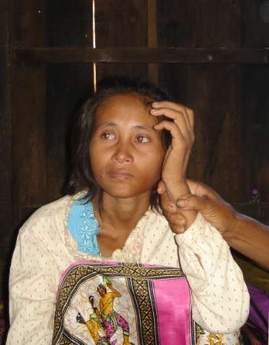
Cambodia 'Jungle Woman' yields no clues


By KER MUNTHIT, Associated Press

Writer Fri Jan 19, 7:01 PM ET
OYADAO, Cambodia -

A woman who emerged from the jungles of Cambodia a week ago, burbling, grunting and walking bent over, is still giving up none of her secrets, even to the family that has taken her in as their presumed long-lost daughter.

Dubbed a "jungle woman" by residents of this remote district in the northeastern province of Rattanakiri, she is claimed by a local family to be 27-year-old Rochom P'ngien, who went missing at the age of eight when herding buffalo in 1988.

But unable to speak any words the villagers can understand, the woman cannot solve any of the mystery that surrounds her disappearance for nearly two decades.

Villagers expressed skepticism Friday that the woman could survive on her own in the jungle and said she was apparently found with her hair trimmed short.

"If she was in the jungle for 19 years, why was her hair short?" said Cheat Ki, a shopkeeper in the village. "It should have been long unless someone cut the hair for her in the jungle."

Many questions remain about the circumstances of her disappearance and what happened to her, said Mao San, police chief of Oyadao district. Officials want to take DNA samples from the parents and the woman to see if they match, and the parents have agreed, he said.

She was captured, naked, on Jan. 13 after a villager caught her taking food from a lunch box he left at a site near his farm, said local police.

Village policeman Sal Lou described his first glimpse of the woman: "She was naked and walking in a bending-forward position like a monkey, exactly like a monkey. She was bare-bones skinny."

Her eyes were red like a tiger's, he said, and he felt fear.

But he checked her right arm. There he found a scar, just as his daughter had from an accident with a knife before she disappeared.

"She looked terrible, but despite all of that, she is my child," he said.

Objective evidence for the relationship, beyond a certain physical resemblance, is thin. But Sal Lou is not the only family member claiming Rochom P'ngien has returned at last.

Rochom Khamphi, 25, said that the moment she arrived at their house with Sal Lou he went to grab her right arm to check for the scar.

"I saw the scar right away and I knew that she is my sister," he said Friday. "Then tears just rolled down from my eyes. That's the proof. I remember it very clearly -- I'm not making it up, because I was the one who caused the injury."

Despite be taken into Sal Lou's extended family, the woman's heart may remain in the jungle. On Thursday she took off her clothes and acted as if she was about to go back into the wild, Sal Lou said.

Restraining her, the family took her to a nearby Buddhist pagoda for a monk to give her a holy water blessing to expel any evil spirits that may have possessed her, he said.

For members of the Pnong minority — who normally are not members of any organized religion, but instead are animists who revere nature — the move was unusual.

"We worship no religion but we took the advice of some elderly Khmer (ethnic Cambodian) people to have the holy water blessing done to chase the evils souls from her body," said Sal Lou, as his presumed daughter sat next to him, motionless as a stone.

She spends her days sitting or lying on the floor, sleeping or staring glassy-eyed at the scores of visitors who come to gawk at her in the dirty, ramshackle house she now shares with 12 other people.

The element of wildness is evident as well to a neighbor, Cheat Ki, and it frightens her.
"I was so scared, scared of evil spirits that might have come with her," she said. "At night before we went to sleep, after seeing her, I told my children to lock the door for fear that some evil might come and strangle us."

Monday, January 08, 2007

The Asia Pacific Leadership Program

The Asia Pacific Leadership Program
East West Center, Hawaii
http://www.eastwestcenter.org/aplp

NEW FELLOWSHIPS AVAILABLE
Entering its sixth year, the Asia Pacific Leadership Program (APLP) is the center of excellence for leadership education in the Asia Pacific region. The APLP is a graduate certificate program combining the development of regional expertise with the enhancement of individual leadership capacity. Based at the East-West Center in Honolulu, Hawaii, the program is creating a network of dynamic leaders from around the world who are familiar with the critical issues and cultures of the Asia Pacific region and trained to work collaboratively. The program involves intensive coursework and field studies. All participants receive an APLP Entry Fellowship valued at approximately $10,000.

Participants
The Asia Pacific Leadership Program seeks outstanding individuals with high leadership potential from across the Asia Pacific region, North America and beyond. All participants have at least a Bachelors degree with the majority having graduate degrees as well. At least 20 countries are represented in each cohort. APLP Fellows come together from all walks of life, including areas as diverse as government, business, NGOs, health sciences, media, monastic orders, and the academe.

Participants will gain a broad regional perspective, become knowledgeable about the critical challenges facing the Asia-Pacific region, and be trained to exercise collaborative leadership and promote cooperation toward the well-being of the countries and peoples of the region. The APLP empowers future leaders with the knowledge, skills, experiences and supportive community needed to successfully navigate personal and regional change in the 21st century.

The program was established through generous funding support from the Freeman Foundation.
Application Forms and Fellowships
For more information about the Asia Pacific Leadership Program, as well as application forms and fellowship opportunities, please visit our website at:
http://www.eastwestcenter.org/aplp
Recruitment for 2007-08 is open. Places are limited. Applications are accepted on a rolling basis. The deadline is February 15, 2007.

East-West Center
The East-West Center is an education and research organization established by the U.S. Congress in 1960 to strengthen relations and understanding among the peoples and nations of Asia, the Pacific, and the United States. The Center contributes to a peaceful, prosperous, and just Asia Pacific community by serving as a vigorous hub for cooperative research, education, and dialogue on critical issues of common concern to the Asia Pacific region and the United States. Funding for the Center comes from the U.S. government, with additional support provided by private agencies, individuals, foundations, corporations, and the governments of the region.