Saturday, May 26, 2007

Maybe it's time to rethink liberal use of Buddhist

In the east China province of Anhui, a monk pours water onto a statue of Buddha during a ceremony to commemorate Buddha's 2,551st birthday on Thursday. (Photo Credit: Reuters, Jianan Yu (China))


Thuc Cong The Edmonton Journal (Canada)
imagesSaturday, May 26, 2007

Nowadays branding is a significant means of earning profits. Marketers try to create consumer desire for products or services by tapping into trendy likes and dislikes.

With Buddhism's growing popularity in western countries, businesses and marketers are using the name and image of the Buddha to promote products.
The Buddha has caught the attention of publishers, film producers, entertainers and even gardeners. Lots of homeowners now tend to display the Buddha statues or Buddha heads in their gardens.

Real Buddhists never use the Buddha and his symbols for decoration purposes. But in supermarkets, lots of products now carry the Buddha brand such as rice, rice cakes, rice flour, rice noodle, even beer (Xinchang Brewery, China). This is a serious branding mistake as the Buddha encouraged his followers not to consume alcohol.

In fact, using Buddha images in marketing is a serious insult. The worst insult occurred in 2004 when Victoria's Secret launched their new bikini design featuring images of Buddha sitting on the front of a halter top or a bottom.

Although the company does no business in Thailand where 90 per cent of population practises Buddhism, the Thai government had criticized the products and the police tried to prevent the import of these products either by businesses or by individuals. The Vietnamese communities in the States also had a petition to boycott these products as the Buddha and Boddhi tree are the ultimate respect to the Buddhists. Printing the image of these sacred symbols on the bikinis (to cover up women's private parts) shows a complete disregard for deeply held beliefs.
Buddhist monks, the representatives of the Buddha, also play a role in marketing. In a travel story published in the Journal on Dec. 23, 2006, photos appeared of Buddhist monks at a place in Phnom Penh. While the stories told by the monks were full of painful experiences (close family members were killed by the Khmer Rouge), the picture of the monks smiling while greeting tourists seemed inappropriate. Indirectly, the image of these monks helped promote the Cambodian travel industry.

Tourists come to Angkor Wat, or Angkor Tom (where Angelina Jolie filmed The Tomb Raiders) just to satisfy their curiosity, not to show respect for the Buddha's land. The temples in Cambodia now become too touristy and the sacred atmosphere seems to disappear.Buddhist monks also have an icon in modern technology. In the Journal Business section on Jan. 27, an advertisement from Cisco Communication featured a Bikkhu holding a laptop surrounded by 11 young novices. The caption "Penalty Kicks. Ladakh, India" suggested the photo was taken in India, the original land of the Buddha.

Once again, the Buddha's land is invaded by advertising industry. From a Buddhist perspective, I think this is a bad sign for Buddhism in particular and other religions in general.Since there are so many misuses of the Buddha's name or his images, it is time to rethink the branding and advertising use of religions. Religious leaders and enlightened beings should get the respect they deserve. That way we can separate our spiritual life from the material life and make our religious life more meaningful.

Thuc Cong lives in Edmonton and has been practising Theraveda Buddhism since she was a teenager.

Towers of power Ancient temples of Angkor survive jungle of Cambodia

05/25/2007

By Jay Solmonson, STAFF WRITER
insideBayArea.com (USA)


SIEM REAP, Cambodia
THE DAYS of hacking through a jungle and fending off leopards and wild elephants before entering the gates of Angkor Wat are long gone.

Most of today's visitors arrive at Angkor Wat's moat-crossing sandstone causeway by air-conditioned bus or car.

The former jungle-smothered temple deep inside Cambodia is suffocated with visitors from around the world. And that was how far my wife and I flew to join 12 friends for a mid-winter weeklong stay at a nearby guesthouse on the outskirts of Siem Reap.

Siem Reap, a little tourist village, is the gateway to the ruins of the ancient city of Angkor, capital of the Khmer kingdom from 802 until 1295. It's abuzz with a building boom. Expensive hotels, along with more humble lodgings, are springing up all over.

Tuk-tuks, a kind of rickshaw attached to a motorcycle, are toting tourists from their lodgings to an ever-expanding collection of shops, bars and restaurants. Yet, there's still enough ramshackle charm in this relatively safe and friendly place to make a stroll along its busy sidewalks a nice diversion from temple touring.

Back alleys near the old covered market draw crowds for simple and tasty Khmer fare. Curries and stir-fries share menus with dishes only for the daring. International visitors can finda taste of home. French, Italian, Chinese, Thai, Japanese, Indian, Vietnamese restaurants and even an Irish Bar have set up shop.

Only in the last decade or so has Cambodia been able to safely welcome tourists. Civil wars and the Khmer Rouge regime kept tourists at bay. Even now, in the midst of a tourist boom, visitors are warned not to wander off the beaten path as Cambodia still suffers from a landmine epidemic that will haunt the country for years to come.

So for our first day of touring Angkor — a vast and mysterious complex and home to about 100 temples — we followed the crowd over Angkor Wat's moat before passing through its outer gate. There, we got our first glimpse of one of the world's greatest archeological sites. It's one of the largest religious monuments in the world.

And it is breathtaking.

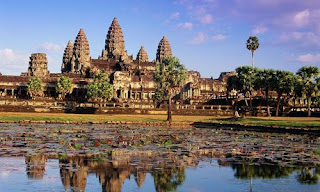
Five massive beehive-like towers rise some 200 feet from the ground. The three-story temple complex, built between 1112-1153 as both a temple and a mausoleum for King Suryavarman II, encloses a square surrounded by intricately interlinked galleries. Its imposing grandeur struck me so much that I felt compelled to bolt from the tour-guided group.

The local guide had just started a long-winded spiel about the bas-reliefs lining the walls of the esplanades. While the bas-reliefs depict fascinating stories and characters from Hindu mythology and historical wars of Suryavarman II, I was just too excited to passively plod along.

With a reluctant nod from my wife, I followed a path into the heart of the temple. In my excitement, I scrambled up a steep rock staircase leading to the top floor of the temple, without thinking of the return trip. When I looked down from the top, I caught a sudden case of vertigo.

The narrow stair treads, only inches wide and with no handrailing, made me think no way was I crawling back down. Thankfully, the 21st century temple elders have retrofitted a railing running down the backside of the monument.

Where were my friends when I needed them? They were still marching along the corridors of the temple where the king's armies have been marching for 1,000 years. I found them just in time for the guide to wrap up his talk.

The following day, we dusted off our Indiana Jones smirks and left the crowds behind. We were headed to a temple of doom called Beng Mealea. The early 11th century Hindu temple is more than an hour from Siem Reap. To get there, you have to travel over bumpy roads running through rural Cambodia where water buffalos have been slogging through rice fields since the beginning of time.

The view from our van's windows of village life amidst the jungle set the scene for the tangle of trees, towers and vines that are Beng Mealea. In the early half of the 20th century, temple and jungle enthusiasts could combine a trip to Beng Mealea with a hunting party since the region was crawling with tigers, panthers and elephants.

In 2007, the crawling is done by tourists who must clamber over huge piles of rubble to see what Mother Nature has spared.

Because of its remote location, civil wars and the Khmer Rouge regime, tourists have stayed away from this still-off-the-beaten-track ruin.

But it's worth the trip. The temple is in a raw, unrestored state where jungle vines and monster-sized tree roots hold a death-grip on what's left of the sanctuary, giving it a haunted charm. Dappled light sneaks through the jungle canopy, making the mysterious temple all the more inviting to would-be archaeologists.

Thankfully, a few carpenters made it there before we did and had fashioned ladders and bridges along with some crude walkways through the crumbling ruins.

Also present were a team of temple guides who literally held our hands as we scrambled over fallen masonry and around huge piles of rubble, climbed over walls and squeezed through windows, (just barely for some of our full-figured friends), before passing through dark passageways on a circuitous route through the temple.

Beng Mealea was the wildest temple we explored, but not the only one left in the clutches of the jungle.

A little tamer, a lot more user-friendly and far more famous and popular is Ta Prohm. Located on the main tourist route not far from Angkor Wat, Ta Prohm receives visitors by the busload. Its status, enhanced by its star turn in the film "Tomb Raider," and its photogenic appeal make it a family favorite.

The 12th-century Buddhist monastery, unlike most other Angkor temples that were painstakingly reconstructed, has been left somewhat the way it was when European explorers stumbled upon it in the late 19th century. Like Beng Mealea, its towers and walls are wrapped in an entangled embrace of tree roots. The filtered light, the shroud of the dense jungle and the labyrinthine inner sanctuary add to the mystery of the temple — until hordes of picture-snapping tourists make you want to yell "Cut!" and to tell everyone to "Take Five!" somewhere else.

But you'd better be able to yell in Korean, as the Angkorian ruins are extremely popular with Cambodia's Asian neighbors as well as with Western visitors.

Although their popularity detracts from their otherworldliness, their towers, corridors and jumbled piles of delicately carved stone blocks sent asunder, make the ruins worth braving the crowds.

Guidebooks differ on the count, but Ta Prohm has been popular for a long time. About 80,000 people were required to maintain the temple. It was home to priests, monks, servants and 600 or so dancers. The others lived in surrounding villages and apparently embraced the temple and supported it with supplies.

Today, many temple walls probably would collapse without the embrace of the trees holding them to each other. Man-made bracing and other structural support help as well. And the only ladies we saw dancing were carved in stone on the temples' walls.

During our weeklong stay we would visit many other temples, all fascinating, but none more beguiling than the Bayon.

The Bayon temple lies within the ancient fortified city of Angkor Thom, just minutes by road from Angkor Wat. Angkor Thom was enclosed by 24 feet high walls and surrounded by a moat 100 yards wide. Snap-happy crocodiles patrolled the moat. The city, about two miles square, had five huge gates, each with a causeway crossing the moat. The 60-foot high gateways were wide enough to welcome a procession of elephants.

The court, religious leaders and officials who lived within the city walls could stand on the beautifully carved Terrace of the Leper King or the Terrace of Elephants bordering the royal plaza, and take in the passing parade. Today, visitors stand where the king once stood to take in a passing parade of a different nature.

Angkor Thom was the capital of the king's empire and apparently the love of his life. One inscription found in the city refers to Jayavarman VII as the groom and the city as his bride, according to Wikipedia.

The city is still much loved by Cambodians and visitors alike, who come to see a variety of temples that can be seen in succession on a short stroll. And none is more beloved that the Bayon.

We were transfixed during our first visit, so much so that when our friends boarded a boat to Phnom Penh, we stayed behind to spend our last few days in Cambodia in Angkor Thom.

And in the heart of Angkor Thom lies the Bayon. Its 54 towers decorated with more than 200 enigmatic gigantic faces have been greeting visitors for hundreds of years. After studying a few of the faces, with their mellow, subdued, charming hint of a smile, we felt like old friends.

Their similarities to statues of the king have lead some scholars to conclude that they represent Jayavarman VII himself, in all his omnipresence.I have no idea what he was like, but the court sculptors portrayed him in all his tranquility. Whether it was real or imagined, whether they did it out of love or under threat, is a mystery.

In the late afternoon the temple emptied, save a few stragglers, a handful of saffron-robed monks and us. We were perched as high upon the temple walls as we could safely climb. The light of the day inched up the towers, darkening the passageways below.

The sun's warm glow swept over the sculpted faces with their downcast eyes and thick lips that curl slightly upwards at the edges reflecting the famous "smile of Angkor" — an endlessly fascinating smile on a face that has launched 1,000 tour buses.

If you go

-When to go. Cambodia has a tropical climate, so it's warm to steaming hot year around. June to October is the rainy season. November to February is the dry season, with January generally being the coolest month.

-Where to stay. Our group reserved all the rooms in Journeys Within Bed & Breakfast inn, nicely located a short cab ride from the airport and the main ruins, and a 10-minute tuk-tuk ride to downtown Siem Reap. The B&B is owned and run by a young couple, an American man and his English wife who made our stay more relaxing than I would have imagined possible.

We ate many of our meals at the B&B after cocktails around the pool. There's nothing like an Angkor beer or a medicinal gin and tonic after a day of temple touring. The inn's Web site is http://www.journeyswithin.

-Photography. Shutterbugs will be snap-happy with all the photo ops in the Angkor area. I was traveling light and only carrying a Canon Power Shot A710IS, a palm-sized point-and-shoot camera. Bring extra batteries and memory cards.

-Health concerns. Visit the Web site of the Center for Disease Control at http://www.cdc.gov for inoculation requirements.

-Information. Lonely Planet's guide to Cambodia is a must read. Helpful Web sites include http://www.wikipedia.org, http://www.cambypublications.com and http://www.khmernet.com. Also worth doing is googling Angkor and Siem Reap.

Thursday, May 24, 2007

Meditation found to increase brain size

Mental calisthenics bulk up some layers
By William J. Cromie, Harvard News Office

People who meditate grow bigger brains than those who don't.

Researchers at Harvard, Yale, and the Massachusetts Institute of Technology have found the first evidence that meditation can alter the physical structure of our brains. Brain scans they conducted reveal that experienced meditators boasted increased thickness in parts of the brain that deal with attention and processing sensory input.

In one area of gray matter, the thickening turns out to be more pronounced in older than in younger people. That's intriguing because those sections of the human cortex, or thinking cap, normally get thinner as we age.

"Our data suggest that meditation practice can promote cortical plasticity in adults in areas important for cognitive and emotional processing and well-being," says Sara Lazar, leader of the study and a psychologist at Harvard Medical School. "These findings are consistent with other studies that demonstrated increased thickness of music areas in the brains of musicians, and visual and motor areas in the brains of jugglers. In other words, the structure of an adult brain can change in response to repeated practice."

The researchers compared brain scans of 20 experienced meditators with those of 15 nonmeditators. Four of the former taught meditation or yoga, but they were not monks living in seclusion. The rest worked in careers such as law, health care, and journalism. All the participants were white. During scanning, the meditators meditated; the others just relaxed and thought about whatever they wanted.

Meditators did Buddhist "insight meditation," which focuses on whatever is there, like noise or body sensations. It doesn't involve "om," other mantras, or chanting.

"The goal is to pay attention to sensory experience, rather than to your thoughts about the sensory experience," Lazar explains. "For example, if you suddenly hear a noise, you just listen to it rather than thinking about it. If your leg falls asleep, you just notice the physical sensations. If nothing is there, you pay attention to your breathing." Successful meditators get used to not thinking or elaborating things in their mind.

Study participants meditated an average of about 40 minutes a day. Some had been doing it for only a year, others for decades. Depth of the meditation was measured by the slowing of breathing rates. Those most deeply involved in the meditation showed the greatest changes in brain structure. "This strongly suggests," Lazar concludes, "that the differences in brain structure were caused by the meditation, rather than that differences in brain thickness got them into meditation in the first place."

Lazar took up meditation about 10 years ago and now practices insight meditation about three times a week. At first she was not sure it would work. But "I have definitely experienced beneficial changes," she says. "It reduces stress [and] increases my clarity of thought and my tolerance for staying focused in difficult situations."

Controlling random thoughts
Insight meditation can be practiced anytime, anywhere. "People who do it quickly realize that much of what goes on in their heads involves random thoughts that often have little substance," Lazar comments. "The goal is not so much to 'empty' your head, but to not get caught up in random thoughts that pop into consciousness."

She uses this example: Facing an important deadline, people tend to worry about what will happen if they miss it, or if the end product will be good enough to suit the boss. You can drive yourself crazy with unproductive "what if" worry. "If, instead, you focus on the present moment, on what needs to be done and what is happening right now, then much of the feeling of stress goes away," Lazar says. "Feelings become less obstructive and more motivational."

The increased thickness of gray matter is not very much, 4 to 8 thousandths of an inch. "These increases are proportional to the time a person has been meditating during their lives," Lazar notes. "This suggests that the thickness differences are acquired through extensive practice and not simply due to differences between meditators and nonmeditators."

As small as they are, you can bet those differences are going to lead to lots more studies to find out just what is going on and how meditation might better be used to improve health and well-being, and even slow aging.

More basic questions need to be answered. What causes the increased thickness? Does meditation produce more connections between brain cells, or more blood vessels? How does increased brain thickness influence daily behavior? Does it promote increased communication between intellectual and emotional areas of the brain?

To get answers, larger studies are planned at Massachusetts General Hospital, the Harvard-affiliated facility where Lazar is a research scientist and where these first studies were done. That work included only 20 meditators and their brains were scanned only once.

"The results were very encouraging," Lazar remarks. "But further research needs to be done using a larger number of people and testing them multiple times. We also need to examine their brains both before and after learning to meditate. Our group is currently planning to do this. Eventually, such research should reveal more about the function of the thickening; that is, how it affects emotions and knowing in terms of both awareness and judgment."

Slowing aging?
Since this type of meditation counteracts the natural thinning of the thinking surface of the brain, could it play a role in slowing - even reversing - aging? That could really be mind-boggling in the most positive sense.

Lazar is cautious in her answer. "Our data suggest that one small bit of brain appears to have a slower rate of cortical thinning, so meditation may help slow some aspects of cognitive aging," she agrees. "But it's important to remember that monks and yogis suffer from the same ailments as the rest of us. They get old and die, too. However, they do claim to enjoy an increased capacity for attention and memory."

Sunday, May 13, 2007

A new day downs

Quiet reflection ... Temple of Angkor Wat in Siem Reap

Though the legacy of Cambodia's troubled past is never far away, Hari Kunzru finds ease and optimism in Phnom Penh, and a country preparing to reinvent itself as a major tourist destination


Sunday May 13 2007

The Observer (UK)

The National Museum in Phnom Penh is a dusty red stone building, whose galleries with high-ceilings surround a courtyard filled with shrubs and trees. Many of the objects it contains are exquisite: prehistoric jars decorated with hypnotic geometric patterns, Angkor-period statues of kings and Hindu gods whose smooth torsos and beatific expressions radiate gentleness - aesthetic worlds away from the gaudy baroque of Indian popular art. Unlike, say, the British Museum, where devices monitor humidity levels and the artefacts appear infinitely distant, frozen in neoclassical limbo, these statues are still functional objects, the recipients of daily religious devotion.

In front of the dancing Shiva and the eighth-century sandstone Ganesh, tilting his head and dipping his trunk into a bowl of water, there are sheaves of burning incense sticks and offerings of jasmine flowers. (The staff make a little cash on the side by selling these to visitors.) In Cambodia, where Theravada Buddhism washes over a Hindu past and an animist love for the particular - the river, the jungle clearing, the spring - it's logical that a museum should be a place of worship as well as learning.

These stone gods and kings feel somehow more precious than their counterparts in the treasure houses of other equally proud countries. They are survivors of Year Zero, the Khmer Rouge's attempt to erase history, proof of the Cambodian ability to create and preserve beauty through the destruction that engulfed their country after the American invasion of 1970.

In one room, there's a statue of the meditating Buddha, perhaps from the 13th century. A little enclosure has been created for it, with a table for offerings, and on the sides of its concrete base the 'four noble truths' of Buddhism picked out in river pebbles: you should know suffering; you should abandon origins; you should attain cessation; and (the odd one out, in French) 'l'ignorance est l'ennemi de la vie'. That is not the usual phrasing of the 'fourth truth', an injunction to follow the path of Buddhist teaching. 'Ignorance is the enemy of life' sounds like the anguished cry of a museum curator, a warning from someone alive in the old colonial days when French was widely spoken. Whatever you do, don't smash the past. Don't forget. Here in Phnom Penh, it's hard not to read a terrible sadness into these Buddhist instructions for transcending the pain of existence.

Across town is a former school known as Tuol Sleng, a cluster of rundown concrete buildings round an open yard. This was once S-21, a secret interrogation centre where Khmer Rouge cadres, many no more than children, used torture to extract insane, florid confessions from their prisoners, who were then driven out of the city to the killing fields. An estimated 17,000 people passed through this place. There were seven survivors.

Tuol Sleng is almost unbearable. Not because of the classrooms partitioned by crudely built brick walls into tiny cells. Not even because of the display of shackles and torture instruments or the lurid paintings done by one of the survivors. The hardest part is seeing the faces of the victims. Everyone brought to S-21 had their picture taken, numbers round their necks, clamped into a device to keep their heads still for the camera's shutter. There are rooms of 10-by-eights of dead people, men, women and children, even tiny babies, 'discarded' (in the jargon of the interrogators) because of their perceived threat to the paranoid members of the Central Committee.

During the three years, eight months and 20 days of Khmer Rouge rule, around 1.5 million people died, out of a total population of 9 million, an event one writer has described as 'auto-genocide'. On the faces of the prisoners of S-21 you see fear, confusion and defiance, but most wear an expression of blank disengagement, a resignation that seems to go beyond the effects of tiredness and hunger, an acceptance that the world they will soon be leaving is filled with horror, and that nothing they could think or do would ever make it change.

Legend has it that when the Khmer Rouge entered Phnom Penh in April 1975, journalists watching from the balcony of the Foreign Correspondents Club left in such a hurry that the people who opened the boarded-up building years later found cameras on the floor, complete with undeveloped images of the fighting. It's now a restaurant, full of tourists eating club sandwiches and reading their Lonely Planet guides, but it's still got a view over the Tonle Sap river and is as good a spot as any to watch today's street life, the vendors pushing carts, cyclo drivers hustling for customers, beefy white men and waif-like Cambodian women getting in and out of tuk-tuks. A dry local joke about the FCC is that it's the only place where the city's many NGO workers have to grit their teeth and make conversation with so-called 'sexpats'.

Around the country, beside posters warning of the dangers of bird flu and landmines (the bird flu one has a picture of a mother scolding her little boy for playing with a dead chicken), you see an image of smiling children, part of a campaign against trafficking and child prostitution. A second dry local joke has it that Cambodians should thank Gary Glitter for this, the issue having shot up the international funding agenda after the huge publicity surrounding the glam-rocker's deportation in 2003.

Today's Phnom Penh has come a long way from the haunted, empty place of 1975, when the Khmer Rouge drove its entire population out into the countryside to grow rice. It's a pleasant city, with bustling markets, elegant colonial-era boulevards, good bars, some startling modernist architecture and an ease and friendliness that will no doubt soon make it one of the most popular destinations in Asia. The incomparable temples at Angkor have long drawn large numbers of tourists, but for years, while the guerrillas were a lurking presence in rural areas and the US and Britain played cold war politics here - helping the genocidal Pol Pot against the Vietnamese-backed government - Angkor was the only place in the country where many foreigners felt safe. Since Pol Pot's death in 1998, security has returned. Little by little, the minefields are being cleared and the shattered infrastructure rebuilt.

Places that were hard to visit a year or two ago are now accessible, thanks to new roads. Elegant French hotels like Le Royal have reopened, offering visitors a flavour of the Indochina of Andre Malraux and Marguerite Duras. And as Cambodia gets plugged back into the global economy, speculators are moving in. Vietnamese and Korean investors are snapping up beaches and ruined villas. Australian mining companies are at work in the forests. In another five years, much of the country will look very different.

Drive out of Phnom Penh and you get a sense of rapid change. Garment factories line the road, which is thronged with motorcycles pulling flat-bed trailers packed with workers, mostly peasants flooding in from the countryside to earn between $30 and $80 a month (the official minimum wage is $45). In the Russian Market you can find branded clothing, some obvious fakes, others the genuine article. Further out into the countryside, boards are nailed to trees, bearing mobile phone numbers. The Khmer Rouge abolished property and destroyed most records. Until recently all land belonged to the state. Now it's a free-for-all. Anyone who can enforce a claim stands a chance of getting rich.

One place that won't stay the same for long is the abandoned hill station of Bokor. Built in the 1920s, it was to Indochina's French elite what Simla was to the British in India, a retreat from the summer heat, a place for intrigue and love affairs. Later it became a Khmer Rouge stronghold: much of the mountain is still heavily mined. To get to the top, you make a bone-shaking 30km climb by dirt bike or 4x4. Bokor is dominated by the melancholy shell of the old casino, which stands on the edge of a cloudy abyss, into which more than one ruined gambler must have thrown himself before war closed the 'Bokor Palace' down. Now its bullet-riddled facade is crumbling and the grand hall is a palimpsest of graffiti, mostly the names of European backpackers. Sokimex, the government-linked petroleum company which also owns the ticket concession for Angkor, is reported to have tabled a $100m plan to build a new road, a 300-room hotel, a golf course and 100 luxury villas at Bokor. While there's no reason to expect Cambodians to live in the rubble of a painful war, Bokor's gloomy beauty will dissipate when it becomes a 21st-century resort, buzzing with the sounds of electric golf carts and credit card machines.

Similar rumours hang around the south coast resort of Kep. Walk along the paved promenade today, and you pass ornate streetlights and the skeletons of beautiful deco villas, adapted with various degrees of serviceability to lower-income living. At sunset, the place is a ghost of Antibes. It takes half an hour on a narrow diesel-engined boat to reach Koh Tansay, where the fishermen have heard that their island, on which the French built a 'motel' (there are no roads) and the Khmer Rouge a re-education camp, is to be the site of a new resort. They do pretty good business, fishing for the famous local crab, frying it with black pepper and serving it to people like me, who come to swim in the lagoon, drink cold beer and watch them mend their nets. They worry, with good reason, that they won't be able to prove this place is theirs, if someone 'high ranking' tries to take it.

The night I sleep on the island an electrical storm passes over, sending an hour of heavy rain and intense sheet-lightning, inverting the night sky so the palm trees look momentarily black against a white background. The boats have come in and the crew are watching TV in a hut. It must be an old film. The voice is the one I've been searching for in markets, the king of Khmer pop, Sin Sisamouth, who like so many other 'new citizens', urbanites whom Pol Pot wished to reprogramme with the values of the peasantry, disappeared into the black hole of the 1970s. Sin liked the twist and surf guitar. Another Cambodian ghost story.

Some things won't change in the next Cambodia: temples, rice. I see Angkor over Khmer new year, when it's swarming with families scrambling up the steep stairs to the sanctuary and taking snapshots. Certain figures (gods, busty apsarases, or nymphs) on the ancient friezes have been burnished to a metallic shine by thousands of hands. Guides run through their spiel in front of the giant stone heads at the temple of Bayon, and the kapok trees curl their roots charmingly round the ruins of Ta Prohm.

A few days later I'm scudding on a motor boat down a long irrigation canal flanked by rice paddies. Men and women thresh rice and pack it into sacks. Sullen Vietnamese traders wait in boats to carry it over the border. From time to time we pass flocks of ducks, penned with chicken wire into little enclosures. Groups of men are fishing, carrying their nets through the water, submerged up to their necks, cigarettes clamped between their teeth. Children wave as we go by. Our destination is Phnom Da, a hill with a simple laterite temple, one corner scooped out by a rocket. 'B40' says Chamroeun, my guide, who knows more than he wants to about munitions.

In 1998, after the mysterious death and ignominious truck-tyre cremation of Pol Pot, the last Khmer Rouge cadres, under 'Brother number five', the one-legged general Ta Mok, made a final stand at an ancient temple complex called Prasat Preah Vihar. Dedicated to Shiva, the destroyer of the Hindu pantheon, it was built between the ninth and 12th centuries by seven successive Khmer monarchs, whose masons hewed out stone stairs and gopuras from a breathtaking peak that looks out over the densely forested mountain range marking the border with Thailand.

Ever since, pilgrims have made their way up, through five successive levels, to the sanctuary at the top. Ta Mok's troops mined the approaches, dug trenches and mounted guns. After a few months they surrendered. The general, already 80 years old, died of natural causes in 2006, while awaiting his endlessly deferred genocide trial. At Prasat Preah Vihar, he left behind an ornate hardwood table, off which I eat dinner, with the guide and the driver and the driver's assistants, young men who laugh and chat and greet their friends, souvenir sellers who are packing up and heading back down to their village. Everyone seems relaxed and optimistic.

At sunset, up at the sanctuary, a party of Thai monks has come to visit. A school trip, perhaps. Many of them are no more than eight or nine years old. I watch one little boy skip, slightly hampered by his orange robe, past the chiselled names of soldiers who once stood guard on top of the holy mountain. Ta Mok was not the first general to lead his men here. Vietnamese names and regiments are written next to those of the Khmer Rouge. But for now, the monks have the run of the place, to climb over the stones and take pictures of one another. At sunrise I wake up in my tent and climb up again to look at the view. A picnicking family have had the same idea. Everyone seems to be looking forward to the new day.

------------

EssentialsHari Kunzru travelled with Audley Travel (01993 838000; www.audleytravel.com). A 14-day tailor-made trip to Cambodia including three nights in Siem Reap, two in Phnom Penh, four at the beach resort of Sihanoukville and a two-night temple safari costs from £1,975 per person. The price includes flights to Bangkok with Eva Air, Bangkok Airways connections to Cambodia and three-star B&B accommodation.

Wednesday, May 09, 2007

For some Chicago Buddhists, Dalai Lama just another teacher

Though many Americans believe the Dalai Lama is the spiritual leader of all sects of Buddhism, many followers view him as just another Cambodian monk. (Photo: Flickr/John Wigham)


May 08, 2007

By Jeremy Gantz

Medill Reports (Chicago, Ill., USA)

To most Americans, the Dalai Lama is the smiling face of Buddhism.

But to Manith Pov, a monk at the Cambodian Buddhist Association in Uptown, the spiritual superstar is just another monk outside of Cambodia's particular brand of Buddhism.


“The Dalai Lama follows the Buddha teaching too, but he takes a little path from the Buddhist book,” Pov said Tuesday. “My [Theravadin] tradition is more strict.” The 39-year-old monk, who practices a form of Buddhism most common in Southeast Asia, came to Chicago from Cambodia three years ago to serve the city’s Cambodian community, he said.

Pov complicates common American perceptions of the world of Buddhism, which is symbolized – some might say idealized – by the 14th Dalai Lama, who gave two sold-out teachings in Millennium Park Sunday.


That the world’s most recognizable monk is just another teacher to many Buddhists may come as a surprise to many Americans, among whom only about 1 percent are practicing Buddhists, according to Harvard University’s Pluralism Project.


No one sect dominates Buddhism, which encompasses Japan’s more well-known Zen meditation traditions and the Dalai Lama’s Tibetan brand.


Each tradition has its own monastic schools and leaders. Bhutan, the world’s last independent Buddhist kingdom, has its own head lama, or religious teacher.


Even the Dalai Lama, although the undisputed political leader of Tibetans, is head of just one of four Tibetan Buddhist sects, the Gelugpa school.


The Diamond Way Buddhist Center in West Town offers a different Tibetan school of thought to Chicagoans. It is one of 500 meditation centers worldwide practicing the Karma Kagyu tradition, according to its Web site.


“It’s a different way of practicing,” Jakub Sowa said Tuesday. “The core of the teaching is the same, but it’s just a different method.”


Sowa, a 21-year-old Diamond Way student, said he first discovered the Karma Kagyu school in Poland, from which he emigrated to Chicago three years ago. He didn’t hear the Dalai Lama speak Sunday, but is looking forward to a visit later this month to Chicago by a prominent Kagyu monk.


But many Americans who discover Buddhism on their own, rather than through family, are more confused than intrigued by the often esoteric differences between the religion’s various traditions.


“Buddhism is a very flexible entity. There’s no separation like [there is] in Christianity,” Richard Brandon, president of the Chicago-based American Buddhist Association, said last week.


“The things that separate them are their languages, customs and ethnicities.”


Susan Gilkey, a doctor at Cook County Hospital who attended an “American Buddhist” service at the Lake Street Church with Brandon on Saturday morning, agrees.


“The [Buddhist] sects can make it difficult to break through to the content. Cultural overlays can sometimes hide the essence of Buddhism,” said Gilkey, 55, who planned to attend the Dalai Lama’s Sunday afternoon public teaching.


Asayo Horibe, president of the Evanston-based Buddhist Council of the Midwest, which works to foster connections between the region’s various Buddhist groups, thinks the Dalai Lama is appealing because he avoids dogma and instead focuses on universal themes.


His big attraction is that he’s not telling everyone to be a Buddhist. You have your own path. He’s giving people credit for having their own mind,” she said Saturday.


Although he follows a different Buddhist path from the Dalai Lama, Sowa, the Polish-born Diamond Way student, believes there can never be one overarching Buddhist leader.


You cannot really consider one teacher more important than another. Buddhist teachings are like a sea,” he said. “Teachers are like rivers that flow to the sea.”

Tuesday, May 01, 2007

Visakh Bochea or Vesak Puja Day: the meaning and practice

Visakh Bochea Day is very remarkable day for all Buddhists around the world. This day has been celebrated to the Birth, Enlightenment and Parinibana of Lord Buddha.

The Birth of Buddha was in the full moon of Visakh lunar month. When Siddhatha Goudama was born from the womb of Siri Maha Maya, His mother in Lumbini Park presently in Nepal, there were appreciation and joy of gods, angels, human beings and animals. The forest, mountains and earth orchestrated the concert to welcome and enjoy the presence of young little Buddha.

The Englightenment of Lord Buddha was in the full moon of Visakh lunar month. After searching for the truth and enlightenment for 6 years, Lord Buddha attained deep into the meditative mind (respiration Vipassana Meditation) deeper and deeper until He enlightened under the Bodhi Tree (Banyan tree) at Uruvela, Buddh Gaya.

The Parinibana of Lord Buddha was in the full moon of Visakh lunar month. After his misson to spread the voice of peace, tolerance, non-violance, loving-kindness and profound paradigm shifts, at the age of 80 years old, Buddha passed away in a deep meditative mindfulness accessed to Nibana under the Sala tree in Kushinara.

Visakh Day is very important for human beings and gods that this day signifies the gate of light for the prosperious world.

United Nations, under its special resolution have recognized Visakh Day as the sacred day for human beings and the UN's staffs to take a break and celebration.