Sunday, May 28, 2006

2006 Reach for the Stars Pan-Asian Youth Leadership Conference

Good morning everybody,

As you know, my name is SOPHAN which means a Bright Man. I am a Buddhist monk and my new name is called VODANO which means A Peaceful Man. I am not from Shoaling, but I am from Cambodia. I was born in a quiet town called Siem Reap which Angkor Wat (the world cultural wonder heritage) was erected there.

Today I am very honored and thankful to all of everybody who has made such a wonderful today. I am not going to talk about Buddhism, but I’m going to tell about my personal experiences in Community Enhancement and Leadership. After I graduated from high school in 1993 I decided to live a life with poverty, a simple life or a monastic way. I thought to stay only three months during the Raining Retreat Season. But through the peacefulness and insight I got from a deep meditation led me to stay longer and longer till now.

As a monk I have met many people with different characters and thought. They come from different directions and backgrounds. They bring to us with both positive and negative perspectives. In this matter, I am on behalf of spiritual leader is not different from secular leaders that I have to be:
- open minded
- flexible
- good interacting
- good communicating
- psychological understanding
- energetic
- hospital
- kind
- and knowledgeable...etc

Mostly, I have worked with youth though I am a youth. Now I am considering that I am a youth although I am a little bit more than 30 years old. I am still young and energetic.
As I am a youth I always have a dream. I think that dream is an important part of my life. Dream I mean in here is not an imaginary or a nightmare. But it is a systematic projecting or our idealistic thinking. Of course, we are naturally having the wandering thinking of mind. Especially, during our childhood and teenager, we always dream this and that. But we have to put it in the order.

All times, when I am thinking of wanting something I want to get it quickly. I want to have it immediately. But it is just a disadvantage of dreaming. Everybody knows that “Rome cannot build in a day”. In order to reach our goal, we have to start our journey step by step with a firm commitment.

The Enlightened One taught us about the Four Basises of Success that:
1. Will or aspiration: set up our dream with a willpower and willingness to achieve our work or duties.
2. Effort or endurance: try to do them restlessly
3. Thoughtfulness: always think and consider about the works or duties we are doing.
4. Reasoning or investigation: always examine and investigate the works or duties we are doing. To conclude and find out that the result is acceptable and useful or not.

It is critical that in order to achieve something we have to set up our goal, try to do it, pay attention with it and check the result. If the result is good and acceptable, pursue our work.

Actually, leadership is very important for individual. It starts from individuals. We can say that we cannot achieve anything if we don’t have leadership in our heart. So leadership starts from individual’s commitment. Firstly, we have to train to lead ourselves. If we cannot lead ourselves, we cannot lead others. If we want to lead others, we have to lead ourselves first.

There are three steps to develop individual’s leadership.
First step: train our mind, purify our mind and empower our mind.
Second step: adjust and concentrate on our speech, improve our communication ability and enrich our verbalizing.
Third step: better our action, correct and improve it.

Naturally, our mind is the forerunner, the master and the commander. It commands us to speak, and through our speech leading to action. So when our thinking is good, our speech is good and our action is good too. But when our thought is bad, our speech is bad and our action is bad too. To be a good leader, we have to be good in training our mind.
When our mind is peace, we will have strong willpower which leads to be a successful leader.

"Love and compassion are necessities, not luxuries. Without them, humanity cannot survive." - Buddha

Venerable Preah Bhikkhu Vodano
---------------------------------------
2006 Reach for the Stars PanAsian Youth Leadership Conference
Saturday May 27th, 2006 - Calgary Opera Centre - 1315 –7th Street SW
Thank you for participating in the 2006 Reach for the Stars PanAsian Youth Leadership Conference!
AGENDA
9:30 am Registration
Breakfast
Mentors Sign-Up
9:45 am Welcome & Icebreaker
10:00 am Keynote address by Veer Gidwaney; Questions & Answers
10:50 am Break
10:55 am Canadian Heritage Presentation by Daniel Larabie & Hai Nguyen
11:10 am Luncheon
11:15 pm Mentorship Intercultural Exchange
12:15 pm Break
12:25 pm Leadership Calgary Presentation by Garvey Chui
12:30 pm Workshop A “Stepping up as Leaders” (2nd Floor) by Hieu Ngo, Coalition for
Equal Access to Education
12:30 pm Workshop B “Film Club” Screening, National Film Board of Canada
- Smita Acharyya, Kelly Isaac, Ben Tsui, Anne Marie-Nakagawa - Panelists
- Janet Miller - Panel Moderator
2:30 pm Announcements of Youth projects
Return Evaluations
Goodie Bags courtesy of Department of Canadian Heritage

Meet Your Mentors
(in alphabetical order, by first name)
Program: Ask Your Mentor Cultural Exchange and Discussion
Time: May 27/2006 -- session #1 @ 11:30AM / session #2 @ 11:50AM / session #3 @ 12:10PM
Summary: Get to know these mentors – read their biographies and pick your top 3. You will join 9-10 friends to interact with the mentor of your choice. Each session with each mentor will last about 20 minutes. There will be 3 sessions in total. During registration, there will be sign-up sheets to secure your spot with your favorite mentors. After you sign up, please circle the session number and the table number to reminder yourself (underneath the photo).
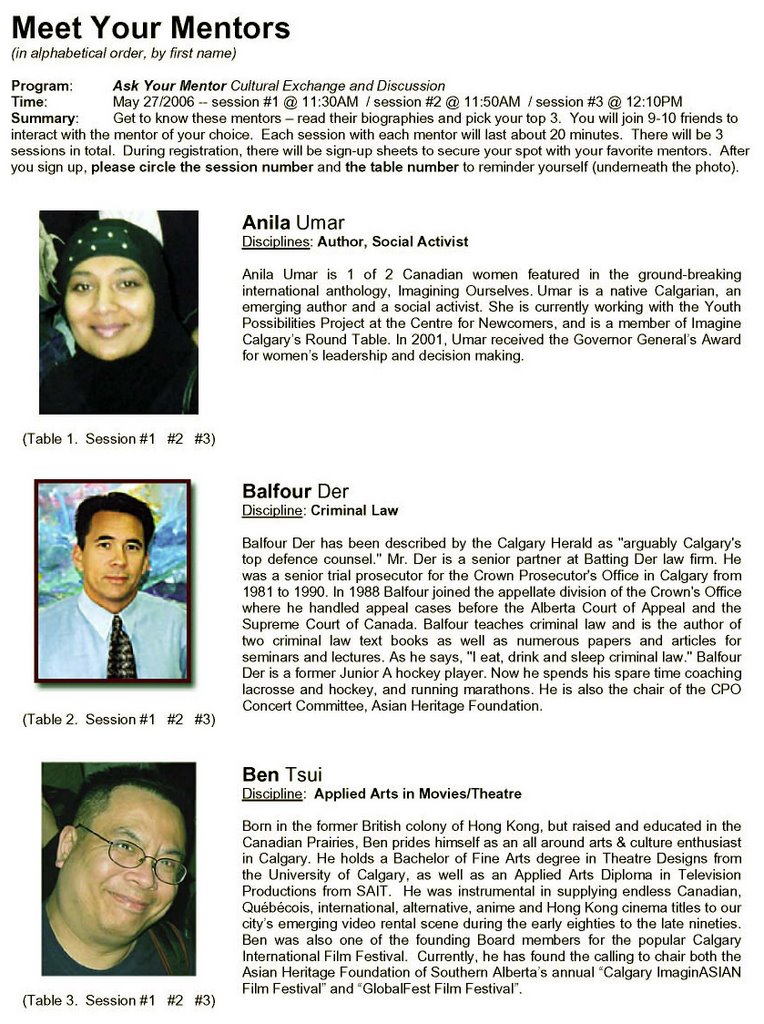
Anila Umar
Disciplines: Author, Social Activist

Anila Umar is 1 of 2 Canadian women featured in the ground-breaking
international anthology, Imagining Ourselves. Umar is a native Calgarian, an
emerging author and a social activist. She is currently working with the Youth
Possibilities Project at the Centre for Newcomers, and is a member of Imagine
Calgary’s Round Table. In 2001, Umar received the Governor General’s Award
for women’s leadership and decision making.
(Table 2. Session #1 #2 #3)


Balfour Der
Discipline: Criminal Law
Balfour Der has been described by the Calgary Herald as "arguably Calgary's
top defence counsel." Mr. Der is a senior partner at Batting Der law firm. He
was a senior trial prosecutor for the Crown Prosecutor's Office in Calgary from
1981 to 1990. In 1988 Balfour joined the appellate division of the Crown's Office
where he handled appeal cases before the Alberta Court of Appeal and the
Supreme Court of Canada. Balfour teaches criminal law and is the author of
two criminal law text books as well as numerous papers and articles for
seminars and lectures. As he says, "I eat, drink and sleep criminal law." Balfour
Der is a former Junior A hockey player. Now he spends his spare time coaching
lacrosse and hockey, and running marathons. He is also the chair of the CPO
Concert Committee, Asian Heritage Foundation.
(Table 3. Session #1 #2 #3)


Ben Tsui
Discipline: Applied Arts in Movies/Theatre

Born in the former British colony of Hong Kong, but raised and educated in the
Canadian Prairies, Ben prides himself as an all around arts & culture enthusiast
in Calgary. He holds a Bachelor of Fine Arts degree in Theatre Designs from
the University of Calgary, as well as an Applied Arts Diploma in Television
Productions from SAIT. He was instrumental in supplying endless Canadian,
Québécois, international, alternative, anime and Hong Kong cinema titles to our
city’s emerging video rental scene during the early eighties to the late nineties.
Ben was also one of the founding Board members for the popular Calgary
International Film Festival. Currently, he has found the calling to chair both the
Asian Heritage Foundation of Southern Alberta’s annual “Calgary ImaginASIAN
Film Festival” and “GlobalFest Film Festival”. (Table 4. Session #1 #2 #3)
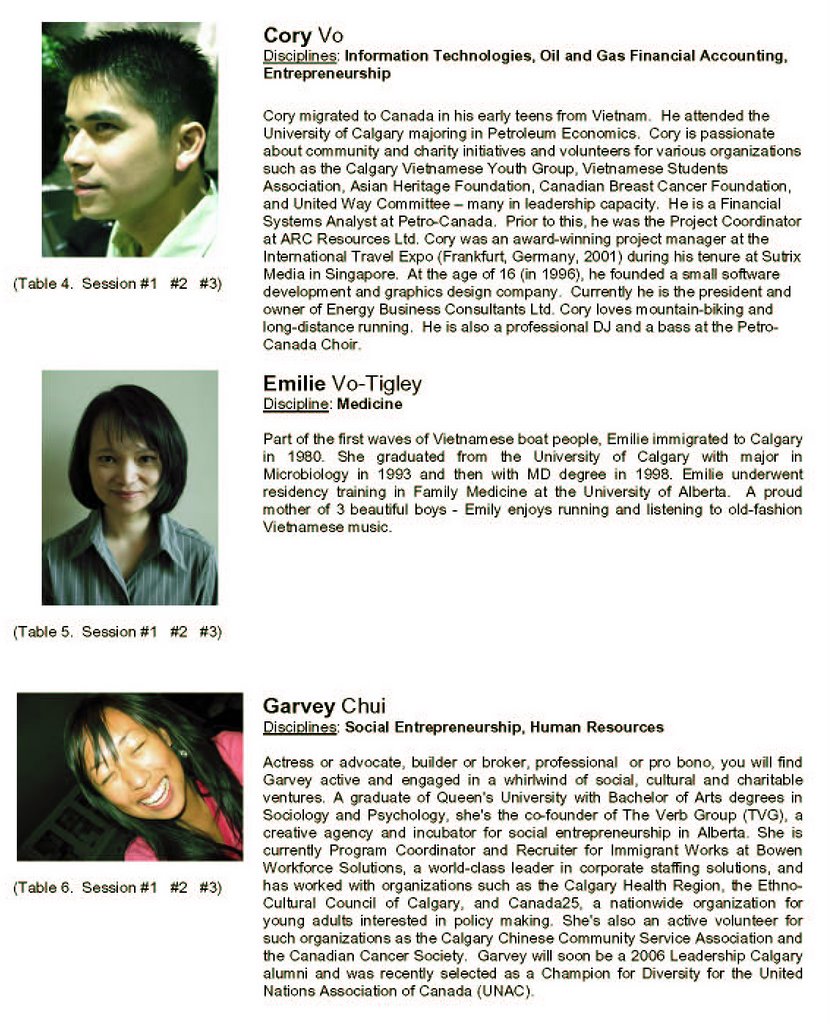
Cory Vo
Disciplines: Information Technologies, Oil and Gas Financial Accounting,
Entrepreneurship

Cory migrated to Canada in his early teens from Vietnam. He attended the
University of Calgary majoring in Petroleum Economics. Cory is passionate
about community and charity initiatives and volunteers for various organizations
such as the Calgary Vietnamese Youth Group, Vietnamese Students
Association, Asian Heritage Foundation, Canadian Breast Cancer Foundation,
and United Way Committee – many in leadership capacity. He is a Financial
Systems Analyst at Petro-Canada. Prior to this, he was the Project Coordinator
at ARC Resources Ltd. Cory was an award-winning project manager at the
International Travel Expo (Frankfurt, Germany, 2001) during his tenure at Sutrix
Media in Singapore. At the age of 16 (in 1996), he founded a small software
development and graphics design company. Currently he is the president and
owner of Energy Business Consultants Ltd. Cory loves mountain-biking and
long-distance running. He is also a professional DJ and a bass at the Petro-
Canada Choir.
(Table 5. Session #1 #2 #3)


Emilie Vo-Tigley
Discipline: Medicine

Part of the first waves of Vietnamese boat people, Emilie immigrated to Calgary
in 1980. She graduated from the University of Calgary with major in
Microbiology in 1993 and then with MD degree in 1998. Emilie underwent
residency training in Family Medicine at the University of Alberta. A proud
mother of 3 beautiful boys - Emily enjoys running and listening to old-fashion
Vietnamese music.
(Table 6. Session #1 #2 #3)


Garvey Chui
Disciplines: Social Entrepreneurship, Human Resources
Actress or advocate, builder or broker, professional or pro bono, you will find
Garvey active and engaged in a whirlwind of social, cultural and charitable
ventures. A graduate of Queen's University with Bachelor of Arts degrees in
Sociology and Psychology, she's the co-founder of The Verb Group (TVG), a
creative agency and incubator for social entrepreneurship in Alberta. She is
currently Program Coordinator and Recruiter for Immigrant Works at Bowen
Workforce Solutions, a world-class leader in corporate staffing solutions, and
has worked with organizations such as the Calgary Health Region, the Ethno-
Cultural Council of Calgary, and Canada25, a nationwide organization for
young adults interested in policy making. She's also an active volunteer for
such organizations as the Calgary Chinese Community Service Association and
the Canadian Cancer Society. Garvey will soon be a 2006 Leadership Calgary
alumni and was recently selected as a Champion for Diversity for the United
Nations Association of Canada (UNAC). (Table 7. Session #1 #2 #3)

Hieu Ngo
Disciplines: Social Work, Social Justice
Hieu Van Ngo is a passionate advocate for social justice. He is the Director of
the Coalition for Equal Access to Education. Concurrently, he is pursuing his
doctoral study in the Faculty of Social Work, University of Calgary. He also
serves as the chair of the All Nations Theatre Society, the co-chair of the
Canadian Coalition for Immigrant Children and Youth, a board member of the
Ethnocultural Council of Calgary, and a grant committee member of the Calgary
Foundation. Hieu Van Ngo received the Terry Fox Humanitarian Award from
1993 to 1997. He was the recipient of the Doctoral Fellowship of the
Government of Alberta in 2005. Currently, he holds the Doctoral Fellowship,
awarded by the Social Sciences and Humanities Research Council of Canada.
(Table 8. Session #1 #2 #3)


Jay Arr Raymundo
Disciplines: Investment/Financial Consulting, Media
Jay is a Financial Advisor at TD Canada Trust. He is also Part Owner and Vice
President Client Relations at Mabuhay Calgary, a monthly newspaper for
Filipino Calgarians. A Bachelor of Commerce graduate from the University of
Manitoba, majoring in Marketing and Small Business Management, Jay is also
a very active community leader. He is a board member of the Philippine
Emergency Response Team (PERT) and volunteer at various organizations
(Asian Heritage Foundation, Junior Achievement). He competes in the Calgary
Men's Basketball League as well as the Filipino Basketball League and Asian
Basketball League. He also volunteers as a coach for Stars Basketball
Program. Jay also trains in Estokada/Kali (Filipino Martial Arts) to stay fit.
(Table 9. Session #1 #2 #3)


Lisa Tan
Disciplines: Marketing, Community Development

Lisa Tan has been an active member of the city’s community events. In high
school, she won the Bow Valley Youth Entrepreneur contest and started her
own clothing design company. One year later, she was chosen to be second
place out of 2055 visual arts entries across Canada in the Butterfly 208
Contest. Since 2002, she has held many leadership positions at various
community organizations throughout Calgary: the Kids Help Phone, Best
Buddies International, University of Calgary EcoClub and the Youth Volunteer
Corps. In 2004, she won the Lion Julie Ann Stevenson Humanitarian Award for
her leadership efforts in the community. Currently, she is pursuing a double
degree at the University of Calgary in marketing and psychology, and works as
a team leader for the organization she once volunteered for: the Youth
Volunteer Corps.
(Table 10. Session #1 #2 #3)


Mark Cruz
Disciplines: Social Work, Disk-Jockey

Mark Cruz is 28 years old. He was born and raised in Toronto but moved to
Calgary in 1997. Mark completed the Social Work Diploma at Mount Royal
College. He is a Youth Worker since 1999 and is currently working at the
Marlborough Teen Resource Centre. Mark Cruz is a professional DJ, and a
member of the Suns of Boey DJ Crew. Mark Cruz’s goals are to enjoy life,
contribute to his community in positive ways, and evolve his DJ skills further,
and create lots of original music. (Table 11. Session #1 #2 #3)

Naheed Nenshi
Discipline: Non-Profit Business Management
Naheed is an educator and consultant based in Calgary. An instructor at Mount
Royal College’s Bissett School of Business, primarily in the Bachelors Degree
in Applied Non-profit Studies, he is also Managing Director of the Ascend
Group, a consultancy focused on helping non-profit and for-profit organizations
grow. His clients include the United Nations and the Gap. Previously, he
taught Corporate Finance and Marketing courses at the University of Calgary’s
Haskayne School of Business and was an engagement manager with the
global strategy consulting firm of McKinsey and Company. A failed amateur
actor, Naheed holds a Bachelor of Commerce degree with distinction from the
University of Calgary – where he was President of the Students’ Union and a
recipient of the largest undergraduate scholarship – as well as a Master in
Public Policy degree from the John F. Kennedy School of Government at
Harvard University, where he studied as a Kennedy Fellow.
(Table 12. Session #1 #2 #3)


Quyen Hoang
Discipline: Art History, Fine Arts
Quyen Hoang was born in Hanoi, Vietnam and came to Canada with her family
when she was eight years old. She studied painting and art history at the
University of Calgary (BFA, BA) and received her Masters Degree in Art History
through Concordia University, Montreal. Quyen has been part of the Art
department at the Glenbow Museum since 2000. She was the curator of the art
exhibit Foreign and Familiar: Reconsidering the Everyday which featured the
works of five contemporary Asian-Canadian artists and is currently working on a
contemporary online art project, funded by the Virtual Museum of Canada.
Quyen also volunteers with the Calgary Vietnamese Youth Group, and was the
narrator in the acclaimed musical production Vietnam Seasons: a 30-year
journey comes to life.
(Table 13. Session #1 #2 #3)


Sophan Seng
Disciplines: Philosophy, Meditation, Pedagogical Development

Sophan shatters every stereotype and misconception that the monastic way of
life is monotonous and solitary. As a Vice-Abbot, Facilitator, Mediator,
Meditation Teachers, and Khmer Language Teacher at the Khmer-Canadian
Buddhist Cultural Centre – life is anything but monotonous. After obtaining his
B.A. in Philosophy, Sophan attended the first year of his M.A. program in
Oriental Epigraphy at the Silpakorn University (Bangkok, Thailand) at which
point his academic pursuit was interrupted by the political tension between
Thailand and Cambodia. Sophan speaks four languages (Khmer, Thai, Laos
and English) and is an expert at leveraging the Internet medium to preserve
and promote the Khmer Language and Culture as well as Cambodian
Buddhism. Sophan was the recipient of various fellowships and awards in
Thailand and Canada for his work in youth outreach and pedagogical
professional development. (Table 13. Session #1 #2 #3)


Online Mentorship Network: We are very excited to introduce the Online Mentorship Network. This will be the first project of its kind in the City of Calgary. Planning is currently under way. A domain name has been secure: http://www.mycoolmentor.com/. This initiative is spearheaded by the Calgary Vietnamese Youth Group. We strongly believe that there are youths out there, who have every desire to develop their personal and leadership skills, but are too shy or do not have the time or resource to attend leadership conferences. The Online Mentorship Network offers a convenient, discrete and supportive environment where mentors and youths can interact, spawn friendships and help the youths reach their highest potential. We expect to launch this project in October 2006. Please check the web site periodically for further development.

Thursday, May 25, 2006

Youn in Khmer language with its consequent misconception and controversy

I am an amateur researcher and a young Khmer boy who is overwhelmed with deep sentiment by foreign narrators about the word Youn. They have intentionally accused of Cambodian people are racist with the term Youn and they said it is pejorative. She compared it like the Americans use the word Nigger refering Black American, or he said it is the savage of Yavana. Of course, there are many Khmer scholars and researchers have already tried to clearify this. I just want to pick up some simple compromising outlining to bridge these two different alien worlds.

Firstly, I am a Khmer boy who has been much influenced with the term Youn by grand parents, parents, relatives, Khmer compatriots, literatures, folklores and history pages...etc described our eastern neighbor(presently Vietnam). The word Youn always come up with both positive and negative depending on the speakers. It is common that a race or nationality can exist of both good and bad in their intimate relationship. So Youn is common for Khmer people to say this word. And it can be interpreted as bad or good according on physical expression, tonation voice or prefix and suffix. For example, if we say "A Youn, Mii Youn, Youn Kontob, Youn Srokey Dong or Chor Youn"; it is absolutely pejorative. But if we say "Bong Paoun Youn, Mit Youn"; it is absolutely positive. So the term "Youn" could not be considered as RACIST or PEJORATIVE like what David Roberts and Trudy Jacobsen described in their articles.

Both Roberts and Jacobsen may claimed themselves that they know Khmer well. But my opinion is that nobody knows Khmer better than Khmers know themselves. Nobody understands the Khmer language better than Khmers understand their own language. Nobody comprehends the term Youn used by Khmer better than Khmers themselves.

Otherwise, we are Khmers are not blind conservative to out-dated past or indulgent with modern foreign influences and doctrination. Everything must go a long with the causes and effects. It must be thoroughly investigated by our efforts, insights and wisdom.

In the past, we had many races in our region like Khmer, Mon, Siam, Laos, Youn, Cham and Java. Among these ancient tribes, Khmer, Mon, Cham and Java are considered dominant in South East Asia. But, Mon is gradually ransacked by Siam and Burma. Cham is totally swallowed by Youn. Khmer is also almost subjugated by Siam and Youn. Present, Khmer consists their land as small as a leave of Bodhi Tree. And she has been frequently terrorized by two giant neighbors through hundreds of year with their strategies of imperialism and extensionism. These two countries have changed their country name and race such as from Siam to Thai and Thailand, from Youn and Namviet to Vietnam and Vietnamese. But we are Khmers are proud to remain our race name to be called Khmer. Our Khmer race is still shattering in Southern Vietnam and Eastern Thailand. Our Khmer lagacy is still scattering in the whole region.

I think those foreign researchers cannot fathom the sorrow of Khmer people throughout their long history; and most of the time the Khmer victims have become the victimizers. It is really unjustic for human beings that are always treated with greed, arrogance, hatred, prejudice and delusion by some people. Of course, the weak must be nurtured and the wicked must be condemned.

Nigger or Nigro word in America is considered as racist because of those new comers tried to eliminate, suppress and enslave them, and called them Nigger. But Youn in Cambodia, Khmers have called them to refer a race who has shared a long history with Cambodia. Most of the time, the new comers of Youn has tried to eliminate, suppress and derogate Khmer people. In our both history pages of Cambodia and Vietnam and the foreign researcher like David Chandler have repeated the victory of Youn, the persecution, the manipulation and the enforcement. For example, they forced Khmer people to dig two long canals. And their manipulation and extensionism policy toward Cambodia is consideringly still implementing in our 21th century.

Actually, Khmers have to adapt themselve in the new age of globalization and technology. We don't hold a strong addiction of any dogmatism or attachment. We have to be flexible; and we learn from wrong to right, not from right to wrong. There are many choices for us, but we will choose the most valuable one. We utilize our free will in which results from our right understanding and right vision. We would like to say thank you for your concerning of Cambodia. But somehow and somewhat, we are Khmers have our own integrity and freedom to destine our destiny. At least, Khmers can sum up with a joint statement that "Nobody knows Khmers better than Khmers themselves. Nobody understands Khmers better than Khmers themselves. Nobody can strenghten Khmers better than the unity of Khmers themselves."


By Bhikkhu Vodano - Canada

Read more articles relating with this issue:
1. Is Using the Word Yuon Justified and Beneficial for Khmer? by Kenneth So
2. Jacobsen history challenged by Touch Bora & Truong Mealy
3. Kampuchea Krom: the friction after the facts by Trudy Jacobsen

Monday, May 22, 2006

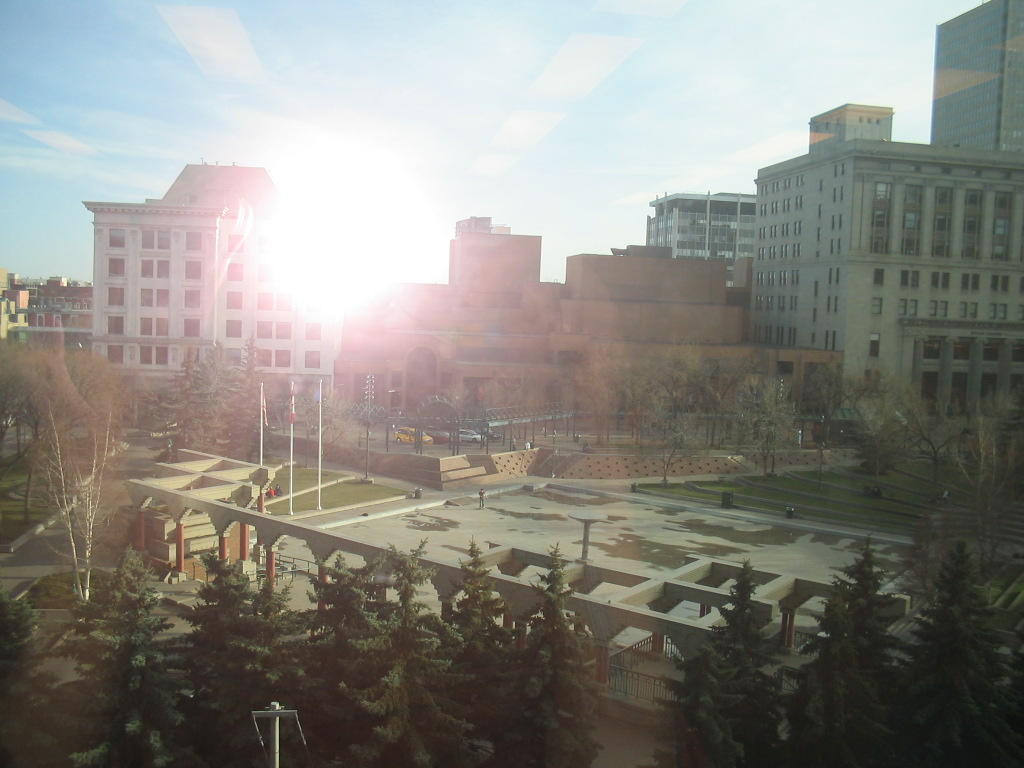
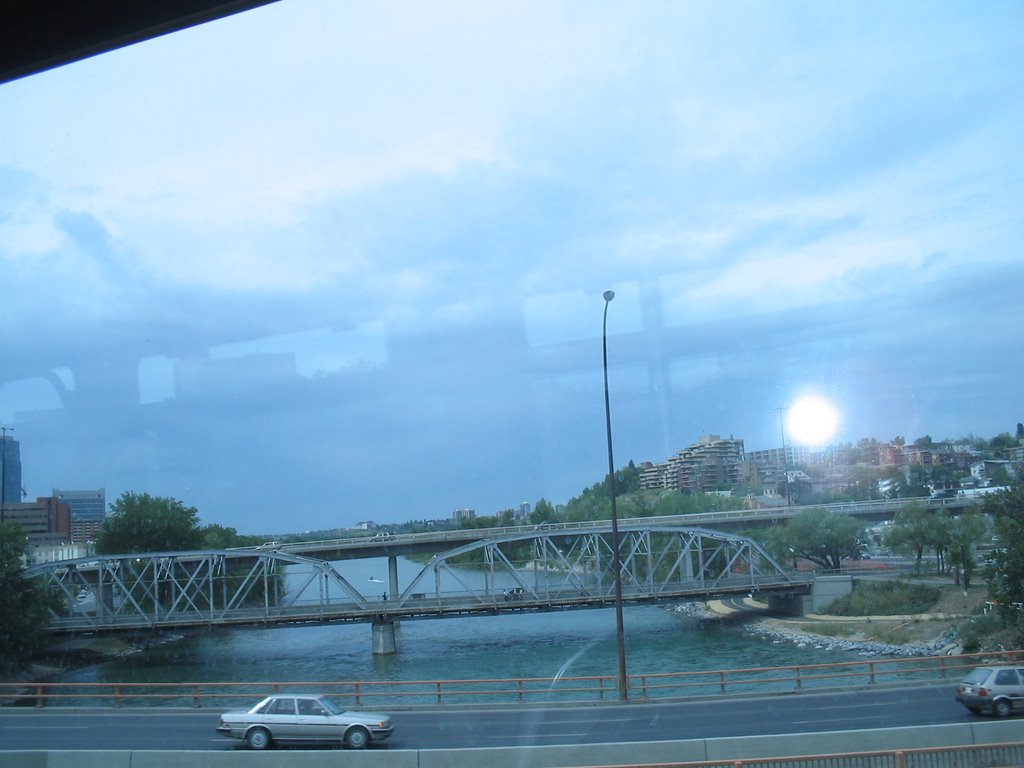
Nostalgia: the City of Calgary, Western Canada


City Hall looking down from Rocky View Mountain Building City Tower and the vicinity under the sunshin of the dust

City Hall looking down from Rocky View Mountain building
Olympic Plaza
Public Library and City Hall
Trafic on the first street and the public library
Bow river at northern corner of the city(picture on the city train)
Building scenary looking from city train
City train railroad and the city building looked far distance from Franklin Station

Thursday, May 18, 2006

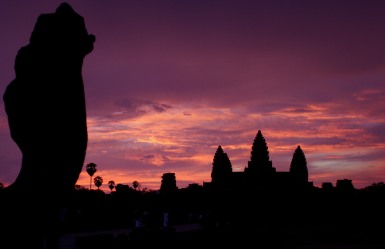
Beyond Angkor Wat: Sadness in Cambodia

Spirit zone: The sun rises above the famous Angkor Wat Temple in Siem Reap province northwest of Phnom Penh, Cambodia. Photo: AFP
Landmine Victims Play Music
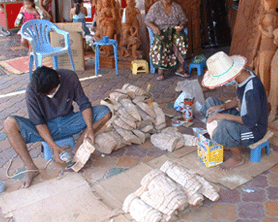
Wood carvers on streets of Siem Reap

Written by Elayne Clift
Thursday, 18 May 2006
Toward Freedom (www.towardfreedom.com)

Siem Reap, Cambodia - It’s the woman with the infant in her arms. I can’t take my eyes off her. More than the other pictures of frightened children, of men with missing ears, their eyes swollen shut, or the faces reflecting sheer terror or numb acceptance, it is her face that mesmerizes me. Maybe it’s that she doesn’t seem to know about the torture.

Perhaps she was still thinking they didn’t kill women, or their babies. But she died here, in this school turned prison, along with 14,000 other people during the Khmer Rouge nightmare in the time of The Killing Fields. When it was over in 1979, half of Cambodia’s population – three million people – were gone. Only seven prisoners were found alive in this hideous dungeon when it was liberated; one was an artist who, without bitterness, has captured on canvas what happened at S 21, the notorious Toul Sleng Prison.

On the streets of Phnom Penh it’s the multitudes of limbless that make me want to stare and look away at the same time. They are mostly men. They are legless, or have no arms, or are blind because of landmines. Children lead them as they beg. Everywhere you go there is begging. Naked little children beg. Women with babies hold out their palms and plead. "Yum, yum," they beseech, a hand on their mouth. Disfigured men and young boys try their best to flog postcards, shoe shines, sunglasses. What you don’t see are old men. They are gone now, gone to Choeung Ek and the other fields of slaughter.

There is also the other Phnom Penh – a city of riverside cafes frequented by tourists, family picnics on the quay as the stifling day draws to a close, hustling tuk-tuk drivers and aggressive vendors, a claustrophobic central market, smiling people who seem genuinely happy to welcome you to their poor country. There is commerce and tourism flourishes as foreigners come to see the Royal Palace and its Silver Pagoda, to light incense at Wat Phnom, or to watch the sunset from a longboat on the mighty Mekong River.

Siem Reap, the rapidly growing and anachronistic base camp town for Angkor Wat, again reveals the abject poverty of Cambodia. Barefoot children, some following older siblings, drift about. Women sell fruit and other goods at roadside stands and small markets. Men languish in hammocks, prostrate from the heat. Yet, amidst its dirt roads and street commerce a bizarre assortment of glitzy four and five star hotels proliferate along the main drag. It is strange and disturbing: Disneyland meets Las Vegas. While Cambodians struggle for subsistence survival, tourists feast on Bacchanalian buffets, shop in upscale craft outlets, and enjoy chauffeured air-conditioned cars.

Behind this eerie façade lies reality. Here is what our guide shared with us. He is self-taught, speaks three languages, and supports his twice-widowed mother on the $10 he earns daily - when he has "clients." His father, sister and brother died during the Khmer Rouge genocide. Corruption is rife in Vietnam-controlled Cambodia. No one cares, he says. Everyone exploits everyone else. Health care is virtually non-existent if you can’t bribe someone to take care of you, and most kids are lucky to make it through eighth grade. Listening to him I feel ashamed and embarrassed by my affluence.

Less than a mile from the glitzy hotels there is a state-of-the-art children’s hospital founded by a Swiss physician, an iconoclast whom many believe violates agreed-upon international protocols for primary health care in impoverished countries. They think this because he uses western diagnostic tools like CT scans, an outrageous expenditure some say, in countries where people don’t even know enough to wash their hands. But this doctor, for all his possible eccentricities, maintains the extraordinary belief that even poor children deserve to live, and saving their fragile lives often requires the same technology that rich kids can access. He is a thorn in the side of the Ministry of Health and, he claims, esteemed organizations like UNICEF and the World Health Organization because he treats babies with non-contagious TB when the resources needed to do that could save a lot of kids with infectious disease. It’s not cost-effective, his critics argue. These kids deserve to live too, he tells the critics, experts who stay in the fancy hotels when they come to Siem Reap to advise or evaluate him. I’d like to have met the Swiss doctor.

Something is amiss in the awesome land of Angkor Wat, one of the manmade wonders of the world. These amazing and prolific Buddhist and Hindu temples, scattered over nearly 200 miles and dating back to the 12th century, are exquisite, mysterious, and revealing. It is a privilege and a pleasure to see them, for no amount of research or documentary footage can capture their grandeur.

But why, I wonder, given today’s technology and the advanced civilization we in the west take such pride in, can there not be other manmade wonders – an end to poverty, for example? An end to childhood mortality from preventable causes? An end to genocide?

Angkor Wat has much to teach us. So does Phnom Penh and Siem Reap. The Cambodian people, gentle and generous, deserve much more than gaping tourists snapping their pictures and bargaining for their souvenirs while they try, yet again, to live. May the awesome monuments of this struggling country never rise above the awful reality of its suffering. It has continued, unabated, for far too long now.


# # #

Elayne Clift, a writer from Saxtons River, Vt., USA, has been teaching and traveling in Southeast Asia for a year. Her book about the experience, AJARN: A Year of Teaching in Thailand, is forthcoming. Photos by Elayne Clift.

Friday, May 12, 2006

Buddhism and Modern Science

by Dr. Granville Dharmawardena, University of Colombo
Original source: http://www.beyondthenet.net/misc/science2.htm
You can see more critical sources about 2550 Anniversary of Vesak Day at:
- Cambodian Vesak Day Celebration Pictures
- Vesak Day Conference in the International Stage
- United Nation, Kofi Annan with The World Buddhist Vesak Day 2550 Anniversary Celebration - Significance of Vesak: Buddha Day
- Vesak Day in Free Online Wikipedia
- Kofi Annan's recognition of 2550 Vesak Day Anniversary

"Buddha is the greatest scientist in the history of mankind."

I have often heard this at bana sermons. This is completely wrong. Scientists are people who are constrained to work solely within and accept only, the knowledge generated by the scientific method. They generally reject knowledge generated by the other method. The Buddha did not use the scientific method and therefore he is not a scientist.

Of the two methods of acquiring knowledge available to the human being the Buddha used the right brain centered intuition method, where as the western approach to acquiring knowledge used the left brain method. The Buddha trained his mind to an extreme high state of enlightenment (Buddhahood) from where he could understand the true reality of nature in its totality. It is based on such knowledge that he propounded a philosophy which is most conducive to balanced and happy living which leads to living in harmony with others, living in harmony with nature, meaningful living devoid of stress, anxiety, jealousy and empty pride, ultimately ending up in a meaningful state full of bliss. That was over 2500 years ago. Science began much later.

Science is often explained as systematic formulated knowledge. It is knowledge needed to understand the phenomena that we observe and those that influence our lives. For the early man science represented a cumulative process of increasing knowledge and ability to understand what is around him. It also meant a sequence of victories over ignorance and superstition. During the time of the Buddha, science was still speculative explanation of common sense observations by intellectuals who devoted much of their time for thinking and understanding natural phenomena. Science helped to develop technology essential for producing things needed to make life more comfortable.

During the seventeenth century the French Mathematician Rene Des Cartes restricted the scope of science to only what is material by bifurcating the universe as matter (res extensa) and mind (res cogitans) and limiting science to the study of the former. The science that evolved on the basis of Cartesian bifurcation was confined to material objects within the limits of perception of human sensory organs which are unable to perceive anything that extended beyond three spatial dimensions.

The above constraints on science stood on the way of achieving its desired objective of understanding the true reality of nature, because nature and natural phenomena are neither confined to matter nor to three spatial dimensions. Many of the important phenomena of nature therefore happened to be outside the scope of science. Science, nevertheless, has provided enormous material benefits to mankind. Therefore people all over the world have very high confidence in science and accept anything explained to them in terms of science. The ultimate aim of science is understanding the true reality of nature, minimizing human suffering and making human beings happy by way of providing material comforts.

The Buddha's way of acquiring knowledge by intuition was not subject to the limitations that stifled science and therefore unlike science the knowledge that the Buddha acquired is complete and represents the true reality of nature. This is confirmed by over 2500 years of experience. For this reason the Buddha did not have any grey areas that need to be hidden under a cloud of imaginary superhuman force.

Just as in science Buddhism does not require its followers to have dogmatic belief in anything that the Buddha taught. The Buddha advised people not to blindly accept what he taught, but research on them for themselves before accepting. For this reason his teachings have remained unaltered and valid for all times and under all circumstances.

While the knowledge the Buddha acquired represents the true reality of nature, what scientists aspire to understand as the ultimate destination of the scientific method, is also the same true reality of nature. While the goal of the teachings of the Buddha is elimination of human suffering and making human beings happy and contented by way of training their minds and creating self discipline in them, the goal of science is providing mankind with material comforts.

In 1905 Albert Einstein broke through the three dimensional barrier in science and took the scope of science beyond three spatial dimensions and Des Cartes restrictions. This enabled man to aspire for a more realistic view of nature and natural phenomena through the scientific method. Modern twentieth century science that developed after transcending the dimensional barrier by twentieth century scientists such as Albert Einstein, Erwin Schrodinger, Louis de Broglie, Paul Dirac, Werner Heisenberg, Richard Feynman, Murray Gellman, Sir Arthur Eddington and Stephen Hawkin is based on the theory of relativity, quantum mechanics and uncertainty principle. These have annihilated the artificial Cartesian bifurcation and extreme materialism in science. By the mid twentieth century the process of gathering scientific knowledge constituted of well organized laboratory and field experimentation, observation, development of theory, prediction, verification of the predictions and general acceptance.

Transcending the three dimensional barrier and taking science beyond the capabilities of human sensory organs eliminated the need to present perceptible mechanisms of observed phenomena as an acceptance criterion. The advent of computers has greatly enhanced the capability of the human brain to tackle complex phenomena that are too formidable to be tackled by the unaided and unenlightened human brain. Computer can never aspire to acquire the capabilities of the human brain because the human brain is driven by consciousness which operates at a speed much faster than the speed of light.

The main achievement of the success of the twentieth century scientists in transcending the three dimensional barrier is acquiring a more realistic understanding of nature and natural phenomena. Twentieth century transcended science enables us to scientifically confirm that such concepts as impermanence, rebirth, telepathy and selflessness taught by the Buddha are true phenomena of nature which are beyond three spatial dimentions and therefore beyond classical science.

Derek Parfit of Oxford University (probably the world's most important living philosopher) accepts the Buddhist view of life and selflessness. He believes that his acceptance of selflessness which was inspired by split brain research, has liberated him from the prison of self. He says,"When I believed that my existence was such a further fact, I seemed imprisoned in myself. My life seemed like a glass tunnel, through which I was moving faster every year, and at the end of which there was darkness. When I changed my view, the walls of my glass tunnel disappeared. I now live in the open air."Derek Parfit, Fritj of Capra (the well known Nuclear Physicist) and Gary Zukav accept the Buddhist view of matter and believes in the need to liberate ourselves from the prison of material particles.

The process of human reproduction is explained in Buddha's teachings as parental union when mother is fertile and the arrival of consciousness. The former supplies the full complement of chromosomes needed to create a Zygote which by normal cell division creates the physical body. The arrival of consciousness into the physical body makes it an individual. Stating with the creation of test tube babies in 1968 by Dr. Robert Edwards's team of scientists at Cambridge University, incredible advances, culminating in cloning in 1996, have taken place in reproductive biology. Yet all these advances have only shifted the site and altered the mechanism of creation of the zygote. The maturing of the zygote to a foetus, making it an individual by the arrival of consciousness and birth remains as per Buddha's teachings.

It is now increasingly becoming clear to those who reach the front lines of modern science that what science has been discovering a new had been known to the Buddha over 2500 years ago. This is confirmed by the following statements made by topmost scientists of the twentieth century.

Albert Einstein regarded as the father of the theory of relativity says,

"Individual existence impresses him as a sort of prison and he wants to experience the universe as a single cosmic whole. The beginnings of cosmic religious feeling already appear at an early stage of development, as an example in the Psalms of David and in some of the Prophets. Buddhism, as we have learned especially from the wonderful writings of Schopenhaur, contains a much stronger element of this.

"Niels Bohr who developed the presently accepted model of the atom together with Earnest Rutherford says,

"For a parallel to the lesson of atomic theory….. (we must turn) to those kind of epistemological problems with which already thinkers like the Buddha and Lao Tzu have been confronted, when trying to harmonize our position as spectators and actors in the drama of existence.

" The most eminent Nuclear Physicist, Robert Oppenheimer, who produced the first atom bomb says,

"The general notions about human understanding … which are illustrated by discoveries in atomic physics are not in the nature of things wholly unfamiliar, wholly unheard of, or new. Even in our own culture they have a history, and in Buddhist and Hindu thought a more considerable and central place. What we shall find is an exemplification, an encouragement and a refinement of old wisdom." - Robert Oppenheimer.

The main teaching of the Buddha is the Noble Eight Fold Path. D. T. Suzuki writes about the first item of this Path, right seeing as,"The seeing plays the most important role in Buddhist epistemology, for seeing is at the basis of knowing. Knowing is impossible without seeing; all knowledge has its origin in seeing are thus found generally united in Buddha's teachings. Buddhist philosophy therefore ultimately points to seeing reality as it is. Seeing is experiencing enlightment".

The teachings of the Buddha, founded on the basis of the true reality of nature, have been recognized to be valid at all times and under all conditions. Buddhism is the only Doctrine based on the true reality of nature in its totality available to mankind. It is now becoming increasingly clear that solutions to most human problems that arise as a result of over indulgence, excessive competition and exploding greed leading to acquiring and amassing unlimited wealth, increasing violence, terrorism, drug addiction and self destruction lie in the teachings of the Buddha. It is clear that Buddhism is getting accepted, the world over, as the way of life of intelligent people in the third millenium.

Sunday, May 07, 2006

Visakha Day: three important events, three important meanings of life

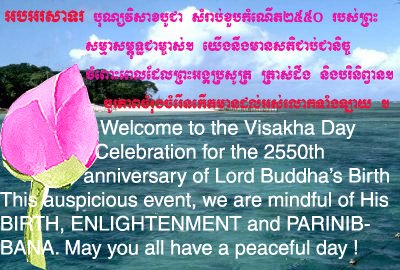
Visakha Bochea Day or the rejoice day of May is an important occasion for Buddhists around the world. It is celebrated in order to worship and pay gratitude to Lord Buddha who has been known as the Enlightened One, Awaken One or the Teacher of Gods and Men. This auspicious event has been also recognized by the United Nations as the world Holy Day, which everybody must pay attention and homage to the world's peace leader and spiritual sage, Lord Buddha. UN has recognized Vesak Day in December 15, 1999 as the International Holiday. We can comprehend this Buddhist commemorate day follows some of my outlining below:

The Meaning
Visakha is a Pali language or Vesak(Sangkrit) means the sixth month of lunar celendar. It coincides in around May 13, 14 or 15 each year. This year all Buddhists around the world will celebrate the 2550 anniversary of Lord Buddha's birthday in May 13, 2006. It always falls on the full moon of Vesak which signifies the three auspicious events related to the history of Lord Buddha when He was alive.

The Three Events
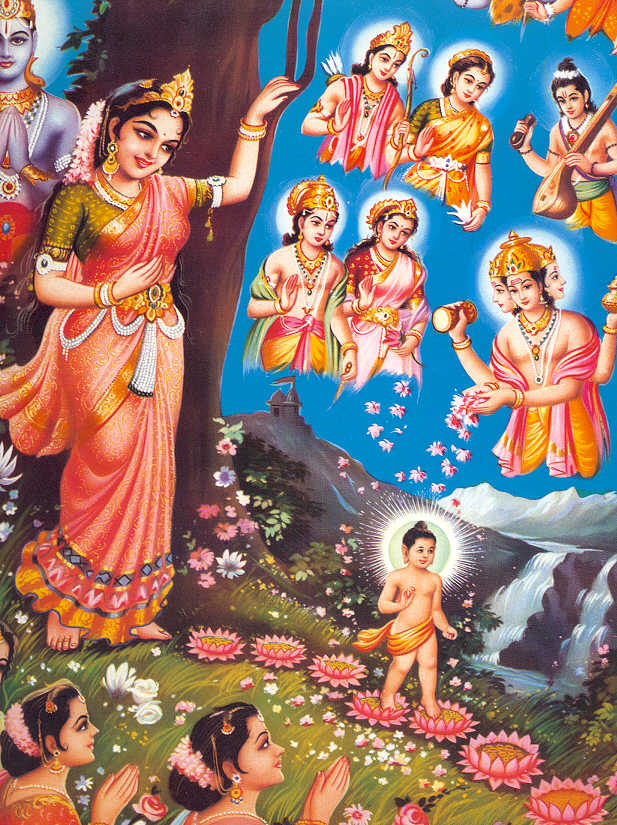
Lord Buddha was born in the full moon of Vesak 624 before Christian. In the accurate scripture(Tri Pittaka) inscribed that "Lord Buddha was born on Friday, full moon of Vesak, the year of Dog in Lumbini Park(or it was May 13, 624 B.C.)"

When he was 29, he renounced the palace to seek Enlightenment. He had practised the former methods of Hinduism's self-denial for six years until his skin emaciated and blood dried out, but he couldn't attain Enlightenment. After that He turned to understand that His experiences in the past of living in palace is the indulgence of sensual pleasure(materialism); and the six years of his self-mortification is the indulgence of self-punishment(asceticism). These two ways are extreme, priceless and waste of time. Finally, Lord Buddha changed to practise middle path which is the way leading to the cessation of sufferings. Then, He achieved the Enlightenment at the age of 35 under the Bodhi Tree of Buddhigaya city. It was Wednesday, full moon of Vesak, the year of Rooster(or it was May 13, 589 B.C.). And he also started His journey from places to places tirelessly to preach the Dhamma and lasted 45 years.

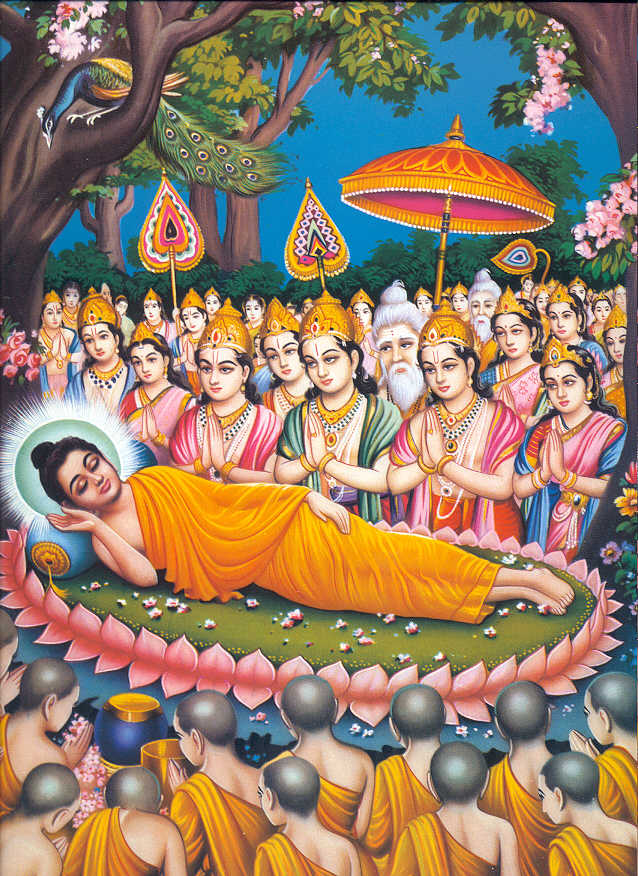
Lord Buddha reached Enlightenment(Parinibbana) at the age of 80 in Kusinara district. It was Tuesday, full moon of Vesak, the year of Snake(or it was May 13, 544 B.C.).

These events are significant period of Lord Buddha's life. He had begun with a genius babihood as he had previously accumulated the merits/goodness of uncountable births of lives; He has grown up as the most intelligent adult who attained the Enlightenment; and He passed away with the smile and lagacy of His accomplishments.

Three Events Reflects Three Role Models for All of Us
Spontaneously, we are all born by the law of Kamma which we have accumulated differently between each others. We are treading in the same path as Lord Buddha who has modeled for us. We were born as a baby, grown up as adult and passed away eventually. But the differences are that on how we can model ourselves as Lord Buddha.

This is very important how we can reshape ourselves in the Vesak Day. We hope to be reborn as a healthy, smart baby with a productive environment, idealized to adjust ourselves to be a successful adult, and ended our life peacefully with a proud lagacy leaving in this world.

We are all, individually; can reach this ideal if we effort to cultivate all good, to avoid all evils and purify our mind. And practise rightly the Buddha's final advice "all compound things are constantly changed and decayed, so strive on with our heedfulness to achieve individual's goal."

Buddha Day
We are called Buddhists derived from our determination to take Lord Buddha as our Refuge, to take the Dhamma as our Refuge, and to take the Sangha as our Refuge. So historically, Buddhists have made their important days to celebrate and pay gratitude to these three Triple Gems. Vesak Day(May 13) is recognized as the Buddha Day. Magha Day(February 13) is recognized as the Dhamma Day. And Asalaha Day(July 10) is recognized as the Sangha Day.

Especially, Vesak Day is the most solemn day that we all have to remind that if we don't have Buddha; we cannot have the Dhamma and the Sangha. In addition, everybody has to perceive that the idealistic Buddhists must be aware of their own Buddhahood in heart. Buddha's teachings has centered on human beings who have full capacity to glorify themselves if they have willingess, right view and right understanding..etc. Human beings have the highest potentiality to outreach their destination. They have got the best opportunity as a human being. Not like heavenly beings who just consume their past merits and they are hard to raise themselves up to Nibbana(highest state of peace).

Cambodia Visakha Day Celebration
We don't have accurate date to state that when Visakha Day has been begun to celebrate in Cambodia? But as we can observe the rituals and celebrations in Cambodia, it might have started since ancient Khmer kingdom.

During this auspicious celebration, Cambodian people have accumulated variety of goodness such as observing five precepts, attending prayer services(Parita Chanting), attending Dhamma preaching, offering flowers to Buddha's statue, offering materials and food to Bhikkhu Monks. Some observe five precepts, but some observe eight precepts. Elder laypeople will stay in temple during a day and a night. In the full moon night, monks and laypeople chant(smout) the Visakha Hymns almost full night.

Methods to Seek Happiness for Our Life in This Day
- Straight our faith to Lord Buddha as once he has offered us the Compassion, Purity and Wisdom
- Pratice the Dhamma right the way
- Recheck ourselves to decrease our selfishness like the Bhikkhu Monks.
- Undertake the five precepts regularly such as: abstaining from killing beings, abstaining from stealing, abstaining from committing sexual misconduct, abstaining from telling lie and abstaining from taking alcohol or addicted drugs.
- Free ourselves from stinginess by making donation or offering food to Bhikkhu Monks, poor people or destitute villagers.
- Calm our mind from all frustrations and stresses by focusing our mind through Concentration and Insight Meditation.
- Be self-awareness
- Reshape ourselves with right understanding and right thought.
- Comprehend and practise correctly the eightfold path: right understanding, right thought, right speech, right action, right livelihood, right effort, right mindfulness and right meditation.


Writen by Preah Bhikkhu Vodano Sophan

Tuesday, May 02, 2006

Is it called INTOLERANCE or AMBITION?

The news about burning church in Cambodia is a rare act of religious intolerance or invasive ambition? It happened in an outskirt village of Phnom Penh capital city in May 2, 2006. According to the news, there were approximately 300 Buddhist villagers bursted into anger and burned a Christian church in their village. As I know this is not the first time happened in Cambodia. In order to understand this matter clearly and seek out the effective way for long term solution; I would like to inspire all readers and news reporters pay attention to the two objectives ie is this Buddhist religious intolerance or invasive ambition of world Christian organization?

Generally, Buddhism is recognized as one of the most tolerant religions in this planet. There are many researchers, scholars or resources have written about this. Problems happened in Cambodia can be considered by some slight aspects of those perpetrators. Firstly, the Buddhist villagers might have personal hate towards those minor group. Secondly, the Buddhist villagers might have less understanding in their own basical, principle teachings which focus on compassion, tolerance, wisdom and non-violence. Thirdly, the minor Cambodian Christians might have much exaggerating verbal about their new conversion. Of course, both sides have had the same fundamental delusion such as those Buddhists have less knowledge in their principle doctrince and those minor Christians have had easy-going to become Christian which is monitored by world Christian missionary.

On the other hand, we cannot say the word "rare act of religious intolerance of Buddhist group..." only because the Christian missionary organizations always have ambition to dominate the world and they have tried to convert people in everywhere with the varieties of strategy. Furthermore, there are many misconducts of Christian organizations in Cambodia like building churches without authority permission, erecting numberious of churches without having a proper members or consent from neighborhood and bribing the local authorities in order to achieve their goals.

I think this slight matter can be an example for the world's religious intolerance issue. Today, only 300 of Cambodian people who claimed themselves Buddhists have burned nearby Christian church, in the future this conflict can happen again in a larger circumstance. Of course, as we can observe, there are many religious intolerance from multitheistic and monotheistic religions. We can research more about this in the words of crusade, inquisition, religious persecution, religious war, jihad or the dark age etc.

One thing that impresses me very much is the consistent, converting ambition of world Christian organizations. They are targeting to those developing countries such Asia and Africa. We can notice that the tactics in converting other faith into Christian congregation is very different between before Second Vatican Council and after Second Vatican Council. However, this new dialogue Catholic Christian strategy is still making intolerance among the world's population.

In order to end this dispute, Christian missionary organizations would think about using peaceful and genuine compassionate mission to dignitize human beings rather than helping but converting them. In the developed countries like USA or Canada; they have no had conversion activities like in Cambodia at all.

So the religious intolerance can be assumed and condemned by not to those mobs but also to those ambitious, consistent dominant organizations.

By Preah Bhikkhu Vodano

Read more details in:
- http://www.news24.com/News24/World/News/0,,2-10-1462_1925549,00.html
- http://www.chinapost.com.tw/i_latestdetail.asp?id=37942
- http://en.wikipedia.org/wiki/Religious_intolerance