Monday, March 27, 2006

Presentation to a Volunteer Group of City Glenbow Museum

Brief Presentation
to a Volunteer Group of Glenbow Museum
in the Asian Gallery
who visited the centre in May 28, 2005
--------------------------------

Cambodian-Canadian Community in Calgary
History and Resettlement
The influence of Vietnamese War had pushed Cambodia into decades of
interior war. During 1975-1979, Cambodia was controlled by the genocidal regime
called Khmer Rouge and there were about two millions of innocent people were
died by the punishment, starvation, over hard work and sickness.

After the Khmer Rouge was overthrown by Vietnamese invasion in January
7, 1979; there were many people were rescued in the refugee camps along the
border line with Thailand. Those suffered people are supported and helped by the
United Nation. And most of them were welcomed to resettle in the new, hoped
land such as USA, Canada, Australia, French, New Zealand, Swiss, etc.

It is the awareness of Cambodian people in everywhere to love their own
way of lives, identity, culture, heritage, language and religion. Anywhere that has
Cambodian people live more than ten families; they shall create their own
community and afford to construct the Temple to centre their identities.
As well as in Calgary when a few Cambodians had arrived before the war and there were a lot Cambodians had arrived after the war. They have resettled almost everywhere throughout Alberta province such as in Edmonton, Calgary, Brooks, Red Deer, Medicine Hat and Let Bridge etc.

Firstly, Cambodian-Canadian Association was created in the year 1980 and
purchased a home to use for monk residence in 1989. Our present Temple was
purchased and renovated in June 22, 2001.

Our Khmer-Canadian Buddhist Cultural Centre here is very useful and
accessible to all people to come and do research independently. As a Non-Profit
Organization, we aim to have our Khmer people enrich the multi-cultural society
of Canada with a sense of peaceful pride.

We give a particular focus to our young, teaching them ethics and self-reliance.
We do this through our Buddhist School, Khmer language classes, insight
meditation, access to internet-computer resources and other youth services and
programs.

Other activities taking place in our Centre are religious ceremonies,
spiritual guidance, ethical observation, bhavana meditation and dana offering.

Cambodian History and Culture
Cambodia is like most of other Asian counties were influenced by the Indian
culture. It was Buddhism and Hinduism which played the important role in
developing and integrating Cambodia into a civilized country. Cambodian ancient
scholars had gradually khmerized those influences into unique Khmer. It has a
long journey combining with the glory and collapsing.

Starting her ancient state that was called Funan(AD.100-600),
Chenla(AD.600-800) and Angkorian Empire(AD.802-1431), Khmer has variously contributed her talent and evolution. During Angkorian Empire, Cambodia was expanded her territory widely from the China Sea to the Gulf of Bengal in the west.

Masterminding in Castles Construction
It is common for each Cambodian king who they ascended to the throne,
they have to build castles or temples to identify his/her glory and to leave as the
legacy for their young generations. Starting from the Funan era till the Post-
Angkorian, the researchers and historians have said that there are more than 1,000
castles was erected throughout Cambodia, Thailand, Laos and Vietnamese.
Angkor Wat known as the largest monument for human kind. It was
built by King Suriyavarman II(AD.1113-1150). It is very beautiful and
incomparable by its size, bas-relief, sculptures and decoration. In the 14th of
December1992, the UNESCO World Heritage Committees declared the
monument, and the whole city of Angkor, a World Heritage Site.

One of these temples- a rival to that of Solomon, and erected by some
ancient Michael Angelo - might take an honorable place beside our most beautiful
buildings. It is grander than anything left to us by Greece or Rome, and presents a
sad contrast to the state of barbarism in which the nation is now plunged (
By
Henry Mouhot, a French naturalist who visited Angkor in the year of 1858 - 60).

To Khmer People, Angkor Wat is more than just an ancient pile of stones, it
is more than just the remains of a highly advanced kingdom, it is more than just a
tourist attraction - to the Khmers it is a symbol of hope.


Angkor Thom or Bayon has the Compassionate Smiles(Bayon Smile) to every one, every corners and all creatures to symbolize the greatness of Cambodian greatest final King; Emperor
Jayavarman VII (AD.1181-1215).

Art Styles
The best of this (Angkor) art combines a sensuous sweetness with luxuriant
magnificence, blending joy with delight with intense intellectual and imaginative
strength!. No film, no photograph, nothing can prepare one for Angkor and its
impact. It is even difficult to speak of it in other than superlative terms. For it is
colossal, enormous, prodigious, startling, awesome...., (By Philip Rawson.),

Language
Khmer language or Cambodian is one of the main Austroasiatic languages,
and has had considerable influenced from Sanskrit, Pali. Some of these influences,
such as Sanskrit and Pali, come from the influence of Buddhism and Hinduism on
Khmer culture; the latter two are the result of linguistic contact and geographic
proximity.

The Cambodian language is somewhat unusual among its neighboring countries'
languages of Thai, Laotian and Vietnamese in that it is not a tonal language.

Dialects are sometimes quite marked; notable variations are found in speakers
from Phnom Penh (the capital city) and Battambong.
(This analysis comes from my observation as a conversant speaker of Cambodian
without any background in linguistics
).

A notable characteristic of the Phnom Penh accent is a tendency toward
slang and laziness in pronunciation, much like American urban slang. For
instance, "Phnom Penh" will sometimes be shortened to "m'Penh". Another
characteristic of the Phnom Penh accent is observed in words with an "r" sub
consonant in the first syllable (that is, where r is the second consonant, as in the
English word "bread"). The r is not pronounced, the first consonant is pronounced
harder than usual, and the syllable is spoken with a dipping tone much like the
"hoi" tone in the Vietnamese language. For example, I have heard the word "dre"
(meaning "fish") pronounced "te"; the "d" becomes a "t", and the vowel (long A)
begins low and rises in tone.

Written Cambodian is alphabetic like English (and unlike Chinese). Its
alphabet consists of two separate categories -- consonants and vowels.
Pronunciation is given here in the traditional form (you will need a computer with
Khmer fonts to see the letters below). It is also notable that the Cambodian script
has fewer vowel symbols than the language has vowel phonemes. Instead, each
consonant symbol has two digraphs, each with its own inherent vowel
(incidentally making Khmer script an abugida rather than a true alphabet. The
actual vowel sound represented is therefore indicated by the combination of the
vowel symbol plus the inherent vowel of its associated consonant.

Way of life
By the influences of Buddhism, Cambodian people are full of kindness and
hospitality to all visitors. They are quiet, gentle and polite. They are easy to welcome every visitor with a unique smile.

There are many occasions that they always reunite together such as:
religious ceremonies like Bon Choul Chnam(New Year), Bon Pachum Ben(Feast
Festival for Ancestors), Bon Visakha Day(Birth, Enlightenment and Parinibbana of
Lord Buddha), Bon Magha Bochea(Caturonghasanipattha, the birth of Sangha community and the announcement of the codes of recluses), Bon Kathin(Saffron robe offering ceremony), Bon Kan Ben(almsfood offering practice), Bon Choul Vassa(Buddhist Lent or Rain Retreat) and Bon
Cheng Vassa(Buddhist out of Lent)…etc. These religious ceremonies are also
regarded as the Traditional Ceremonies.

Buddhism: General Perspectives
INTRODUCTION
The name Buddhism comes from the word 'budhi' which means 'to wake up' and
thus Buddhism is the philosophy of awakening. This philosophy has its origins in
the experience of the man Siddhartha Gotama, known as the Buddha, who was
himself awakened at the age of 35. Buddhism is now 2,548 years old and has
about 400 million followers worldwide. Until a hundred years ago Buddhism was
mainly an Asian philosophy but increasingly it is gaining adherents in Europe,
Australia and America.

BUDDHA
Who was the Buddha?
Before he became a Buddha, Siddhartha was a prince. But he wasn't just any old
prince, his mother had prophetic dreams before he was born and wise men made
great predictions about his destiny.

Leaving the Palace
During an excursion outside the palace walls, Prince Siddhartha was so deeply
affected when he saw a sick man, an old man and a corpse, he decided to leave the
palace and become a monk.

Under the Bodhi Tree
Nibbana or Enlightenment is the goal of all Buddhists. This means putting an end
to the suffering we experience in life. The Buddha endured six years of physical
hardship as a monk before he attained Enlightenment whilst meditating under the
Bodhi tree.

What the Buddha Taught
The most important Buddhist Teaching is the Four Noble Truths. This explains
why we suffer and what we can do to eliminate suffering from our life. After the
Buddha attained Enlightenment, this was his first Teaching. His first lucky
students were five monks he knew.

The Buddha's Disciples
Sangha - the Buddha's male and female disciples, during his lifetime and right up
to the present day. Although Sangha traditionally refers to monks and nuns, these
days it also refers to lay followers of Buddhism.
Loving-Kindness
The Buddha taught that positive qualities such as loving-kindness should replace
negative ones such as selfishness. One way of doing this is through meditation.
Without developing a good heart, it's impossible to achieve lasting happiness.

The Buddha's Last Days
The Buddha on the last stage of his journey. Even great teachers must die, and the
Buddha was no exception. However, his death was by no means the end of the
story. Today his Teachings are still very much alive.

Who is a Buddhist?
This unit defines a Buddhist as one who takes refuge in the Triple Gem (the
Buddha, Dhamma and Sangha), and willingly follows the Five Precepts. These are
rules for living a moral life, and include not killing, stealing and lying.

Four Noble Truth
1. The truth of suffering such as birth, aged, sick, death, sorrow, lamentation,
physical pain, grief, despair, association with hateful ones, separation from
loved one, not getting what one wants and the five groups of
grasping(clinging).
2. The truths of the cause of sufferings are defilements, ignorance and craving
or greed, hatred and delusion.
3. The truth of the cessation of sufferings is Enlightenment or Nibbana.
4. The truth of the ways leading to the cessation of sufferings: Eightfold Path.

Five Precepts
I undertake to:
1. Abstain from killing living beings;
2. Abstain from taking that which not given;
3. Abstain from sexual misconduct;
4. Abstain from false speech;
5. Abstain from distilled substances that confuse the mind. (Alcohol and Drugs)

The Five Precepts in positive terms
I undertake the training precept to:
1. Act with Loving-kindness;
2. Be open hearted and generous;
3. Practice stillness, simplicity and contentment;
4. Speak with truth, clarity and peace;
5. Live with mindfulness.

The Three Signs of Existence or Universal Properties
1. Anicca — Impermanent;
2. Dukkha — Unsatisfactory, stress inducing;
3. Anatta — Insubstantial or Not-self.

The Four Sublime or Uplifted States
1. Metta — Friendliness, Loving- kindness;
2. Karuna — Compassion;
3. Mudita — Joy, Gladness. Appreciation of good qualities in people;
4. Upekkha — Equanimity, the peaceful unshaken mind.

The Eight Fold-Path
Right, Integral, Complete, Perfected...
1. Right View, Understanding;
2. Right Attitude, Thought or Emotion;
3. Right Speech;
4. Right Action;
5. Right livelihood;
6. Right Effort, Energy, and Vitality;
7. Right Mindfulness or Awareness;
8. Right Samadhi "concentration", one-pointedness. Integration of, or establishment in, various levels of consciousness.

Creation of Sangha(monk) community
A few months after his enlightenment the Buddha founded an order or Sangha of
monks. The purpose of this order was twofold. Its primary purpose was to provide
a community that would give the optimum opportunity for its members to practice
the Dhamma and attain Nibbana. Its secondary purpose was to transmit the
Dhamma and be a witness to its transforming power.

Becoming a Monk
• To become a novice (samanera) all that is needed is to approach a monk of
at least 10 years standing and ask to be accepted. After undertaking several
years training and being at least 20 years old the novice is qualified to be a
fully ordained monk. To do this he must approach an assembly of 10 monks
each of at least 10 years standing who are respected for their virtue and
learning. The candidate is then asked 11 questions to determine his
suitability. (1) Are you free from disease? (2) Are you a human? (3) Are
you a male? (4) Are you a free man? (5) Are you free from debt? (6) Do
you have any obligations to the state? (7) Do you have your parent’s
permission? (8) Are you at least 20 years of age (9) Do you have your robe
and towel? (10) What is your name? (11) What is your teacher’s name? If
the candidate answers these questions satisfactorily and if no objections are
raised by the assembly, he is considered to be a fully ordained monk
(Bhikku). A monk can use property belonging jointly to the sangha but he
himself is supposed to own only eight things - three robes, an alms bowl, a
razor, needle and thread, belt, and a strainer to purify drinking water. He is
also obliged to abide by the 227 rules contained in the Vinaya Pitaka.

Meditation
• There are two kinds of meditation: Concentration Meditation (Samatha)
and Insight Meditation (Vipassana)
1. Concentration Meditation means you control your mind to be a pointedness
mind.
2. Insight Meditation means you are aware or noting every movement of
thought.

Seven Benefits of Mindfulness Meditation
1. Purification: this mindfulness meditation must be practiced for purification
of beings. This is the first benefit. If you are mindful of any mental or
physical process, if your concentration is good enough, at the moment of
deep concentration on this mental or physical process your mind is purified.
It's free from all kinds of mental defilements, all kinds of hindrances.

2. Overcoming sorrow: then the second benefit is overcoming worry, sorrow
and lamentation. The second benefit is sorrow and worry. You overcome
sorrow and worry even though you failed in your business. You don't worry
about it; you don't feel sorry.

3. Overcoming lamentation: When you have completely realized the mental
and physical processes and their true nature by means of mindfulness
meditation, even though your relative dies, or even though your sons or
parents die you won't cry over it. You have exterminated this lamentation
for the dead.

4. Overcoming grief: Then, the fourth benefit is the overcoming of grief. In the
full retreat you can do away with grief, when your mindfulness meditation is fully
practiced. Here grief means mental suffering. Mental suffering is exterminated,
done away with, by this mindfulness meditation.

5. Overcoming physical suffering: And also pain here means physical suffering.
All kinds of physical suffering are destroyed through mindfulness meditation.
There are some who cured illness by means of mindfulness meditation. The fifth
benefit is overcoming physical suffering, dukkha. Mental suffering is known as
domanassa in Pali. Physical suffering is known as dukkha. Domanassa is mental
suffering, mental dukkha. Physical suffering is dukkha itself. These two aspects of
suffering are removed by means of mindfulness meditation.

6. Enlightenment: Then the sixth benefit is attainment of path knowledge. That's
one of enlightenment. In Buddhism there are four stages of enlightenment a
meditator has to attain through his mindfulness meditation, after he has completed
all thirteen stages of insight knowledge
. The first stage is known as sotapannamagga
. The second stage is known as sakadagami-magga
. Third stage is known anagami-magga
. The fourth stage is known as arahatta-magga.
All these four stages of enlightenment can be attained when you have thoroughly realized
anicca, dukkha and anatta of bodily and mental processes. When impermanence,
suffering, the impersonal nature of body-mind processes are thoroughly realized
then you can attain all these four stages of enlightenment.

7. Nibbana:Then finally you attain to Nibbana by mindfulness meditation. What
do you mean by Nibbana? Where do you see Nibbana, on earth or underground or
in heaven or in the sky? Ah, but the Buddha said Nibbana is in you. The place
where you attain to Nibbana is yours, your body and mind. Unless you have
realized your body-mind processes you cannot attain Nibbana. Only when you
have fully realized your body-mind processes and two levels of understanding,
then you are sure to attain Nibbana. So Nibbana is with you, not very far, very
close.

Compiled and Written by VENERABLE VODANO SOPHAN

Friday, March 24, 2006

Domestic Violence: a silent crisis in our society

Sample Essay of iBT TOEFL TEST
What recent news story has affected you the most? In what ways has it affected you? Use reasons and examples to support your response.
Response Time : 30 minutes
---------------------------------

For me, the most affected recent news story is about the domestic violence happened in Calgary last week. I found it in a local newspaper and shook me terribly. It's the most recent affecting news because it intimidates individual's safety, can damage the society's order and has bad consequences for future generation.

Actually, everybody needs safety in daily life. But one of those dangerous things is a person whom she has loved. He(husband) had killed her with a gun and shot himself in the head later. There was blood in the basement as a woman laid on the floor, and a dead man at the garage. Who can we trust for the individual's safety?. It's hard to answer as the domestic abuses are still a silent crisis in our society.

From this silent disaster can leads to the collapsing possibility of our society's infrastructure. Then it will result an instability, disorder and chaos. People feel frustrated, fearful and stressful. So when the important strength of individuals has been disrupted, it can lead to the destruction of the society. We cannot calculate that how many families and individuals have been terrorized by domestic abuses. But one thing which we perceive is the endless fear occurring in our society.

Thirdly, when parents have committed abuses, it affects their children, or leaves their children parentless especially the couple I have mentioned above. They left their three children with aunty. And a three years old baby says that his parents go to heaven. We aren't sure his parents go to heaven or not, but what we are sure now is that he is still crying and calling the name of their parents. So we cannot imagine how the boy suffers and how he grows up in the future?. Truly, the three children will be orphan and experienced an unforgettable history in their life.

Domestic abuse is really horrible thing happening in our society. It has rooted as the slightest thing of individual bad actions and these bad actions gradually grow up if they don’t destroy it primarily. It has secretly planted in individual's dirty mind. It creates a lot of flaws in families and companions; and it seems hard to get rid of it. This news is really affecting me and it promptly inspires me to become an activist to fight against this silent crisis. The most fundamental origin to deal with this crisis requires individuals to understand and effort to cultivate three achievements: to do all good deeds, to avoid all bad deeds and to cleanse our dirty mind.

Note: Any kinds of abuses are wrong in the concept of Buddha’s teachings. It is a sinful action. We have to respect the Dhamma and take it for refuge in order to refine our mind. Mind is the main cause leading to commit such bad actions(unwholesome Kamma). Those bad Kammas are considered as battering, hurting, shouting, swearing, intimidating, sexual humiliating, oppressing, addicting alcohol and drugs..etc.


This sample essay is written by VODANO SOPHAN

Tuesday, March 21, 2006

Philanthropic works in a sense of Cambodian

Philanthropic work is for the people who love and share their heart to service human beings. They can do either volunteering or contributing materials to humankind. There are many scattering societies in our planet which need our help and sharing. Those are in need of life necessities, loving-kindness, compassion, education and encouragement etc. Some are affected by civil war, by natural disasters, by pandemics and harsh living conditions. For Cambodians, they have ever had the traumatized experiences during the war of Vietcong and genocidal regime of KR. Through this suffering, they have learned a lot about philanthropy.

Firstly, we share our heart consisting of loving-kindness, compassion, sympathetic joy and balancing judgment(equanimity). Love or loving-kindness is very important in the first stage of how we can engage to a broader heartfeltness. There are many levels of love such as love between parents and children, siblings and siblings, friends and friends, or girl friends and boy friends. Or we can further our love toward nature or animals, or always love ourselves. There are many definitions focusing on to whom the people love most?. The accurate answer should be the "self" that people love most. For example, I love myself, you love yourself, they love themselves or we love ourselves etc. Aptitude of self's love is boundless. So individuals have to extend the self's love to others indiscriminately. Further more, love or loving-kindness is like an instinct of human nature. In order to better it, they have to develop their love to become "compassion". Love and compassion have two different aspects. Love is like we see a beautiful picture and begin to like it, but compassion will stamp our mind into it or in a deep memory which we will never change our heart. Third advantage is to increase "sympathetic joy" in our loving-kindness and compassion. Mostly, loving-kindness and compassion will never get into implementation. When we develop "sympathetic joy"; it will become an empirical practice. Finally, our works, practices or implementations will not be biased when we have developed our equanimity. Balancing mind or equanimity means not to be biased by love, fear, hate and ignorance.

Secondly, they should volunteer with many other charitable works which focuses on either social or natural issues. For the non-profit social organizations deals with child prostitution, domestic violence, human trafficking, orphanages, poor-conditioned scavengers, child beggars, war-amputees, destitute villagers, remote poor conditioned students or those are in need. Some social issues are concerned in education promotion, ethical outreaching program and public health. For the non-profit natural organizations works to protect deforestation, wild life extinction, global warming, eco system or environment…etc. Those fields of charitable tasks require everyone's participation and contribution. Nowadays, there are many volunteers in Cambodia such as monks, students, officials, soldiers and general public have shared their vision and energy to better their society, especially Buddhist monks who have continually accomplished this. Each temple is the symbol of volunteerism. Individually, at least spend two or three hours per week to join volunteering projects in order to engage us with other and to care our social sustainability.

Thirdly, beside of using our energy to volunteer we should spend a small piece of our income to earn goodness and merits by contributing to non-profit organizations, poor people, or religious charity. In doing so, it means we understand well the welfare of living together. Life's purposes define as how can we share our goodness with others, it is not selfish greed or stinginess. Up to present, there are many Cambodian people who have contributed some of their income to support neighbors, to improve their society and the whole globe. Especially, Cambodian people who are living in abroad always send their money to help develop Cambodia. Each year, hundred of millions of foreign currency flows into Cambodia from Cambodian people in abroad. Some of them send directly to their relatives. Some of them help through various organizations that interest in building temples, schools, digging well and others. In addition, if they send directly, they have shared with only two people between the giver and receiver. But if they send through a trustful organization, they can establish Khmer unity and sustain it in a wider way.

In conclusion, philanthropic works can be called a social work or social participating. Cambodian people are same as other people around the world have taken keen interest in this field. Their vision is to leave the goodness, sacrificing personal greed, selflessness, virtue, compassion and good sample to the young generation. Our life will be ended with empty hands, but only goodness left. I encourage everybody to spend some of our energy and material for the welfare of our neighbors and sustainable, global betterment.

by BHIKKHU VODANO S. SOPHAN

Tuesday, March 14, 2006

Buddhist Meditation & Scientific Researches

The Pursuit of Happiness
CBC News Online April 23, 2004
Reporter: Eve Savory
Producer: Marijka Hurko
From The National

Erin Gammel is a shoo-in for the Canadian Olympic swim team. Canadian record holder, champion backstroker – unless something wildly unexpected happens, she's going to Athens. But four years ago she was a sure bet for the Sydney Olympics, too.

"Everyone kept telling me you're a shoo-in," she says. "And we had the strategy and everything was perfect. And I thought this is it, I'm going to the Olympics.

"She was racing at the Olympic trials in Montreal. She hit the lane rope, lost her concentration and lost her place on the team.

"It was just extremely disappointing. I was depressed. I was just really sad. I was crying and I couldn't control myself," Gammel says.

Erin Gammel cried for two years. Help was to come in a way she would never have dreamed, from Dharamsala in Northern India, 5,000 kilometres and cultural eons away.

Dharamsala is the home in exile to thousands of Tibetans who followed the Dalai Lama, after China occupied Tibet. For 25 centuries Tibetan Buddhists have practised and refined their exploration.

For generations they probed their inner space with the same commitment with which western science explored the external world and outer space. The two inhabited separate worlds.

But now, they are finding common ground in a remarkable collaboration.

In March 2000, a select group of scientists and scholars journeyed to Dharamsala. They came to share insights and solutions – to human distress and suffering. Among them was Richard Davidson, a neuroscientist from the University of Wisconsin. He finds nothing contradictory about doing science with Buddhists.

"There is almost a scientific-like attitude that is exemplified by Buddhist practitioners in investigating their own mind," he says.

"Their mind is the landscape of their own experimentation, if you will.

" The westerners had been invited by the Dalai Lama himself to his private quarters. For five days, monks and scientists dissected what they call "negative emotions" – sadness, anxiety jealousy craving, rage – and their potential to destroy.

One of the participants, Daniel Goleman, author of the book Destructive Emotions, says, "As we were leaving the U.S. to come here the headline was a six-year-old who had a fight with a classmate and the next day he came back with a gun and shot and killed her. It's very sad.

"Why would the scientists seek answers in Tibetan Buddhism?Because its rigorous meditative practices seem to have given the monks an extraordinary resilience, an ability to bounce back from the bad things that happen in life, and cultivate contentment. Richard Davidson's lab is one of the world's most advanced for looking inside a living brain. He's recently been awarded an unprecedented $15-million (Cdn) grant to study, among other things, what happens inside a meditating mind.

"Meditation is a set of practices that have been around for more than 2,500 years, whose principal goal is to cultivate these positive human qualities, to promote flourishing and resilience. And so we think that it deserves to be studied with the modern tools of science," Davidson says.A little over a year later, in May 2001, the Dalai Lama returned the visit to Davidson's lab in Madison, Wis. His prize subjects – and collaborators – are the Dalai Lama's lamas, the monks. "The monks, we believe, are the Olympic athletes of certain kinds of mental training," Davidson says. "These are individuals who have spent years in practice. To recruit individuals who have undergone more than 10,000 hours of training of their mind is not an easy task and there aren't that many of these individuals on the planet.

"The Dalai Lama has said were he not a monk, he would be an engineer. He brings that sensibility – the curiosity and intellectual discipline – to the discussion on EEGs and functional MRIs. But this isn't really about machines.

And it isn't about nirvana. It's about down-to-earth life: about the distress of ordinary people – and a saner world. "The human and economic cost of psychiatric disorder in western industrialized countries is dramatic," says Davidson. "And to the extent that cultivating happiness reduces that suffering, it is fundamentally important.

"The monk and the scientist are investigating – together – the Art of Happiness."Rather than thinking about qualities like happiness as a trait," Davidson says, "we should think about them as a skill, not unlike a motor skill, like bicycle riding or skiing. These are skills that can be trained. I think it is just unambiguously the case that happiness is not a luxury for our culture but it is a necessity.

"But we believe we can buy happiness…if we just had the money. That's what the ad industry tells us. And we think it's true.

People's theories about what will make them happy often are wrong. And so there's a lot of work these days that shows, for example, that winning the lottery will transiently elevate your happiness but it will not persist.There's some evidence that our temperament is more or less set from birth. So and so is a gloomy Gus…someone else is a ray of sunshine – that sort of thing.

Even when wonderful or terrible things happen, most of us, eventually, will return to that emotional set-point.

But, Davidson believes, that set point can be moved. "Our work has been fundamentally focused on what the brain mechanisms are that underlie these emotional qualities and how these brain mechanisms might change as a consequence of certain kinds of training," Davidson says.His work could not have been done 20 years ago. "In fact, 20 years ago, we had dreams of methods that allows you to interrogate the brain in this way, but we had no tools to do it.

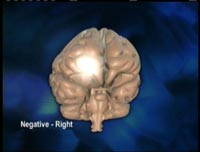
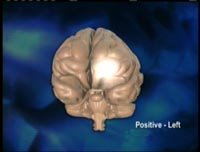
" Now that we have the tools we can see that as our emotions ebb and flow, so do brain chemistry and blood flow. Fear, depression, love … they all get different parts of our brain working.Happiness and enthusiasm, and joy – they show up as increased activity on the left side near the front of the cortex. Anxiety, sadness – on the right.

Davidson has found this pattern in infants as young as 10 months, in toddlers, teens and adults.Davidson tested more than 150 ordinary people to see what parts of their brains were most active. Some were a little more active on the left. Some were a little more active on the right.A few were quite far to the right. They would probably be called depressed. Others were quite far to the left, the sort of people who feel "life is great.

"So there was a range. Then Davidson tested a monk.

He was so far to the left he was right off the curve. That was one happy monk.

"And this is rather dramatic evidence that there's something really different about his brain compared with the brains of these other 150 people. This is tantalizing evidence that these practices may indeed be promoting beneficial changes in the brain.

"Here, the Olympic athletes of meditation meet the Cadillac of brain scanners. Khachab Rinpoche, a monk from Asia, came to Madison to meditate in perhaps the strangest place in his life: the functional MRI.

It let's scientists watch what happens inside his brain when he switches between different types of meditation. They want to know how his brain may differ from ordinary people, and whether that change is related to the inner contentment the monks report.

So they test how subjects react to unpleasant sounds and images flashed into the goggles they wear in the MRI.

Normally when we're threatened one part of the brain is tremendously active, but in the monks, "the responsivity of this area is specifically decreased during this meditation in response to these very intense auditory simuli that convey strong emotions," Davidson says.

It's very preliminary work, but the implication may be that the lamas are able to move right through distressing events that overwhelm the rest of us – in other words, one of the keys to their happiness.

It may tell us something about our potential. "Our brains are adaptable, our brains are not fixed. The wiring in our brains is not fixed. Who we are today is not necessarily who we have to end up being," Davidson says. Tibetan Buddhism is said to be one of the most demanding mental endeavours on the planet. It takes 10,000 hours of meditation and years in retreat to become adept. Few of us can imagine such a commitment.

But that doesn't mean the benefits of meditation are out of our reach.

Zindal Segal is a psychologist at the Centre for Addiction and Mental Health in Toronto. He uses meditation to treat mood disorders.

It's based on Buddhist teachings and its called mindfulness.
Michael Herman, senior partner with the law firm of Goodman and Goodman, meditates in his office.

"Very few of us can sit for 10,000 hours to be able to do this but the interesting thing is that we don't need to. These capacities are available to all of us," Segal says. " We're talking about paying attention, we're talking about returning wherever our minds are to this present moment. These are things that we all have. We don't have to earn them, we just have to find a way of clearing away the clutter to see that they are already there.

" Meditation is now out of the closet. The word is, it eases stress, drops blood pressure, helps put that bad day at the office in perspective.

Meditation is being mainlined by the mainstream, from corporate offices to factory floors.

These days it's not unusual to find hospitals like St. Joseph's in Toronto offering meditation programs. Some 360 people pass through the eight-week course every year. Like most, this program has taken the simplest form of Buddhist teaching and adapted it for busy lives. "Meditation is a skill, and like any skill it needs to be practised. So we use the breath as the place where we start to practise but eventually what we want to be able to do is to be able to use the awareness of the breath in our daily lives," Segal says.

"When we have the ability to do that we can then use the breath when we're standing in line at a bank, or if we're having an argument with a spouse, as a way of grounding ourselves in the middle of something that is disturbing.

" Something disturbing, like the mind movie Erin Gammel couldn't escape: the day when she failed to make the Olympic team.

"I just remember my hand getting caught in a lane rope and thinking to myself, it's over," Gammel says. She lost her focus, her place on the team, and her heart to swim. "It affected my entire life. I cried at the drop of a hat. I wasn't improving and it didn't look like anything was really improving. And I felt everything I did I seemed to fail at," she says. "That was part of the depression and the sadness because I felt like I was failing at the time. Nothing was going well." Until she hooked up with the National Swim Team's sports psychologist, Hap Davis. Davis had been fascinated by scientist Richard Davidson's work.He had a hunch that reliving the trauma was suppressing that part of Erin's brain on the left that Davidson had found was so active in happy people.

He devised a rescue plan – a breathing meditation that she was to do before and after repeatedly viewing the video.

"If a person can ground themselves and feel centred with meditative breathing they can get to the point where they can look at it and view it with a critical mind, with a mind that is capable of being open to the experience and looking objectively at what took place," Davis says.

"You know what it felt like during the race. It felt like I stopped absolutely dead. But in the video I look and it looks like just a little glitch. Nothing.

"It's more than two years since they've needed to study the tape – because it worked. Erin's joy of swimming returned; she's winning race after race.

"She's more resilient emotionally. She's more stable emotionally. She's more consistent in terms of performance," Davis says. "Meditation isn't necessarily about happiness but it makes you happier. I guess that is how you would say it. And I feel more confident. That I know how to work with this stuff and work with bad things that happen in my life," Gammel says.

Once again there's one more race to win – the trials to make the team that goes to Athens.

"This is my year. That's what I keep telling everyone. This is my year to make the Olympic team because making it through all those times there it's just going to happen, I know it is. lt's just going to happen," she says.

"Meditation has been around for 2500 years so it's not like a new practice," Davis says. "But science is catching up to an old tradition and the evidence seems to be emerging that meditation can change the pattern of brain chemistry or blood flow in the brain.

"And now there's proof meditation can change the brains of ordinary people and make them healthier.

Promega is a biotech company in Madison, Wis., where the researchers from the Brain Imaging Lab recruited typical stressed out workers – office staff, managers, even a skeptical research scientist, Mike Slater. "Things were chaotic and crazy. We had a newborn. We had three deaths in the family. So it was a pretty topsy-turvy time," Slater says.

All the subjects had activity in their brain measured…and half – including Mike Slater – were given an eight- week course in meditation.Then everyone – meditators and controls – got a flu shot, and their brains were measured a second time.

The meditators' brain activity had shifted to that happy left side. Mike Slater was almost too successful. "I was pretty happy all the time and I was worried that maybe I was masking some stuff that might really be irritating me so I stopped it and my wife noticed an increase in my irritability, so, you know, I have both sides of the experiment now. It calmed me down and I stopped doing it and my irritability increased," he says.

That wasn't all. Their immune systems had strengthened. "Those individuals in the meditation group that showed the biggest change in brain activity also showed the biggest change in immune function, suggesting that these were closely linked," Davidson says.Davidson and his team had shown meditation could shift not just mood – but also brain activity and immunity in ordinary people.

And they'd answered a potential flaw in the monk study.

"Someone may say, well, maybe these individuals are that way to start out with. Maybe that's why they're attracted to be monks," Davidson says. "And we actually can't answer that on the basis of those data, but with the Promega study, we can say definitely that it had to do with the intervention we provided.

"There are reasons to believe the insane pace and many aggravations of daily life can be dangerous to the health of our minds and our bodies.

We can't push the delay button on a busy world and we can't bail out. But perhaps meditation is a way to encourage a sense of well-being – a deep breath in the centre of the whirlwind.

"As the Dalai Lama himself said in his book The Art of Happiness, we have the capacity to change ourselves because of the very nature, of the very structure and function of our brain," Davidson says.

"And that is a very hopeful message because I think it instills in people the belief that there are things that they can do to make themselves better."